
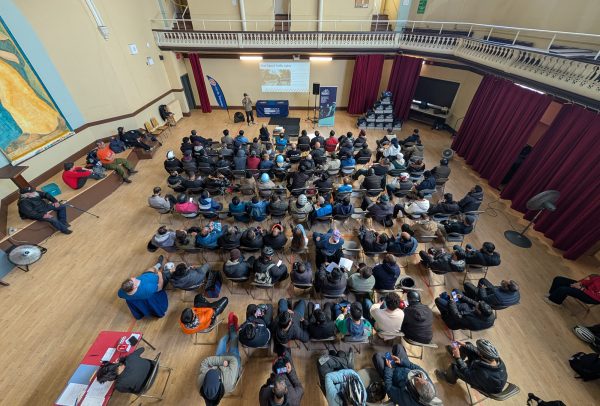
“See, I learned!” exclaimed a young man as he walked his rather large e-moped on the sidewalk. Our volunteers are obviously jazzed at the apparent quick returns from the Cycling Sessions for App Based Delivery Riders (e-bike and e-mobility devices users) organized by The Biking Lawyer LLP, Toronto Bike Brigade, Tom Flood, and Cycle Toronto.
Now, are we patting ourselves on the back in pre-emptive celebration of having resolved all conflicts between road users after a few 45-minute workshops, free lights, and delivery bag giveaways? No. Do we think we’ll get the odd email from folks who’ve spotted a Biking Lawyer bag worn by someone skirting the law? Probably, yes. But the goal wasn’t to create a perfect solution. Just perhaps a workable one that could be a scalable option for municipalities and food delivery companies to more effectively address community concerns over the growing number of people using e-bikes for gig work.
That’s where this idea came from, community concerns. On the one hand we saw story after story in the press of politicians demanding action to address allegedly dangerous e-bikers on our roads and sidewalks (without any data on collisions to support their demands). This we generally have balked at for its gut-reaction, inauthentic feeling. Really, we’re going to confiscate someone’s e-bike for riding on a sidewalk but not a motor vehicle that rolls over one into a daycare?
That said, we also ride our bikes along the Bloor-Yonge corridor, to work, for exercise, and to run errands. We see the cycling community chat groups discuss near misses and understand how it feels sharing bike lanes or walking on sidewalks next to large battery-propelled vehicles. So, we did some informal community polling to see what our fellow cyclists’ concerns were (passing without notice, riding while on the phone, passing on the right, etc.) and ordered 500 Biking Lawyer branded delivery bags.
Our goal: to incentivize safe cycling amongst a group of hard-working time-pressed individuals (and get some free advertising).
To get the bag, you had to attend a session on the Rules of the Road, Cycling Etiquette, Bike Safety, What to do in a Collision, and How to Avoid Police Tickets. It wasn’t clear what the response would be, but quickly it became clear that not only was this session popular, but these working cyclists were ready to engage and share their experiences. What do I do if someone sells me an illegal bike or non-UL battery. What can we do to organize access to washrooms while we’re working, and so on.
Each of the three days the crowd grew, 60, 70, and then 100. Each day more people left the safe cycling sessions better equipped to keep themselves, and other road users, safe. Yes, the business model behind their gig work prioritizes speed and risky maneuvers to ensure your smoothie is delivered on time, but by way of a show of hands of who’s been hit by a motorist or nearly hit (hint: the whole crowd). Their safety matters to them too.
We are delighted by how things went. No, not much media showed up to hear from us or the hundreds of young men (and some women) who are so often vilified and voiceless in articles quoting councillor concerns over their riding behaviour. But the word got out to the gig worker community. The emails for free bags, and another workshop, are still coming in.
Importantly, we’ve created a model for those councillors and others to actually reach those they are concerned are riding dangerously. If our rider walking his e-moped on the sidewalk is any indicator, it’s also a working model of how to encourage safe behaviours that doesn’t task our 1.5 billion dollar police force with handing out hundreds of dollar tickets to (mostly) racialized working young people (education over enforcement).
Meaningful dialogue and active listening in a collaborative environment are key first steps in addressing community concerns; we believe that a little empathy can go a long way.
David Shellnutt is the founder of The Biking Lawyer LLP.
Photo courtesy of The Biking Lawyer LLP.

3 comments
Delivery apps need to step up: cycling safety sessions for gig workers should be mandatory AND paid. Many riders are newcomers who simply haven’t been taught our local laws. A little education goes a long way.
This is a great initiative! I cringe every time I see a delivery person dressed entirely in black with no reflective tape on the bag and no lights. Especially at night time in the rain. Thank you for taking the right approach with education and empathy.
I live in the Yonge/Eglinton area. The e-bike delivery people are everywhere, on sidewalks, going the wrong way on a one way street, cutting in and out of traffic, some with no lights or reflective material at night.
I’m on my bike on Bloor, or College and these e-bikes go bombing by. I’m trading an unsafe street for an unsafe bike lane. Without strong and enforced regulations, I don’t bother any more.