The handprinted broadside below was one of my first and most memorable encounters with the works of Glenn Goluska (1947-2011), celebrated today as one of Canada’s most influential fine press printers. The primary colour palette and use of wood type to illustrate an abstract typographical cyclist animates the page, as if jolting the text to stagger the lines below.
Emulating both the visual and textual practices of French modern artist Fernand Léger (1881-1955), Goluska also reworks a passage from the artist’s essay Le Cirque (1950, see Functions of painting p. 170-171) into verse. The text is a meditation on the embodied experience of cycling: presenting the bicycle as “a ballet / where the instant / flirts with eternity. / It commands legs, arms, and torso / churning from below, at the sides / and from above.”
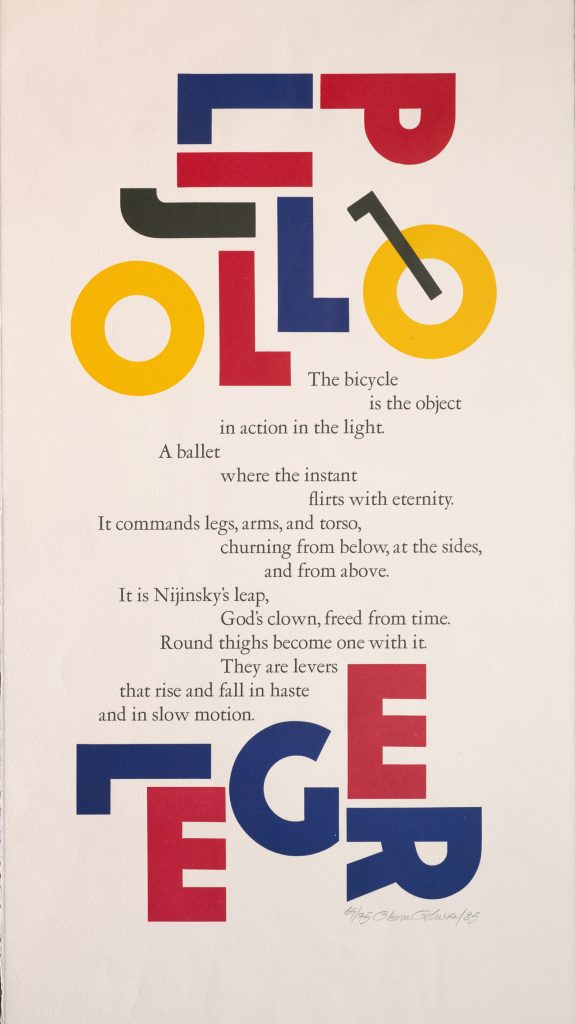
Goluska’s passion for cycling at least in part explains his affinity with Léger’s work, but perhaps, on some level, the message also resonated with his craft: the text, mirroring its own making, just as readily describes the embodied practice of letterpress printing.
What is letterpress printing?
Canada is home to a vibrant fine press community made up of artists, publishers, and collectors who keep the knowledge of letterpress printing alive today: using antique presses and equipment, binding books by hand, making and decorating paper, and all other handicrafts that fall under the umbrella of the book arts.
Working with bulky, specialized equipment on tight budgets, it is not unusual to find printers and bookbinders setting up shop in basements, sheds and garages – or old laneway buildings, like Toronto’s celebrated independent publisher Coach House Books.
This brings us back to the matter at hand: acquainting Toronto laneway enthusiasts with print enthusiasts.
Enter: Glenn Goluska
Born and raised in Chicago, Goluska moved to Toronto in the early 1970s to study at the University of Toronto, returning to his hometown with a B.A. and an M.A. in modern languages (Russian, French, and German), and his wife, a fellow UofT student, Chicago-native, and bookbinder, Anne Bratton (now Sutherland). In 1975, during a visit to Toronto, Goluska dropped by Coach House Press and convinced founder Stan Bevington to hire him based on phototypesetting skills he picked up in Chicago, recalling Bevington’s first assignment— “go upstairs and type yourself a job offer for Immigration” (Glenn Goluska in Toronto p. 11, see cap 11081).
While making an impact and gaining recognition at Coach House, Goluska also established his private press, imprimerie dromadaire (1976), to print books, pamphlets, and broadsides guided by his own literary and creative interests, operating from his various homes in the neighbourhood over the years. He would write or select texts, design, typeset, illustrate, and print materials, with design support and bookbinding by Anne.
In 1980, Goluska quit Coach House to establish his own commercial imprint, the Nightshade Press, a decision largely credited to Margaret Atwood, who, following her own letterpress roots, sought a printer to design her next poetry volumes, published under her own short-lived Salamander Press, according to Robert Bringhurst’s retrospective of his life.
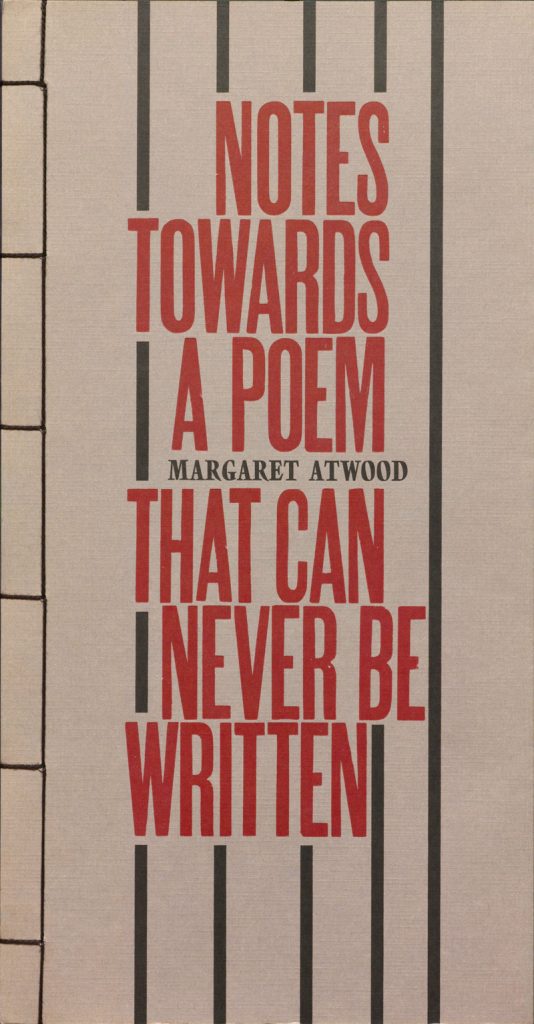
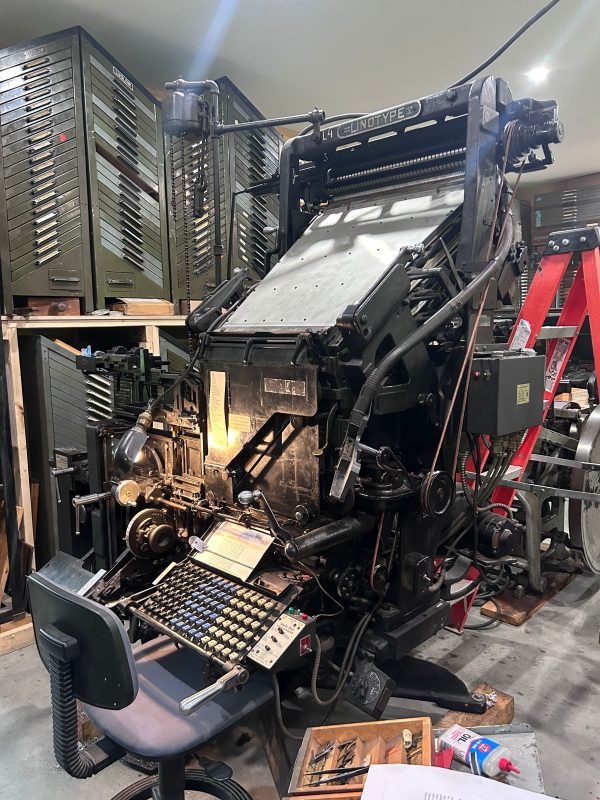
A decade later, Goluska moved to Montreal to design for the Canadian Centre for Architecture and McGill-Queen’s University Press. Over the course of his career, he earned many awards, including the Alcuin Society’s Robert R. Reid Medal for Lifetime Achievement in the Book Arts in Canada in 2011, just months before he lost his life to lung cancer. Goluska left his Linotype and collection of type to Nova Scotia-based printer and typographer Andrew Steeves (then Gaspereau Press, and more recently, Press of the Varying Hare), where it continues to be put to active use.
The Stable
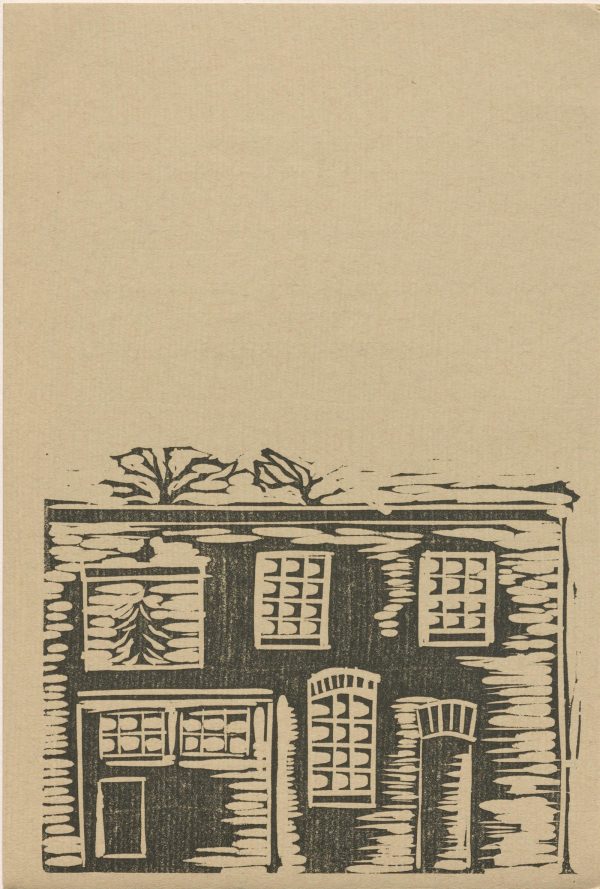
Created in 1985, we know precisely where The Bicycle broadside was printed: 105 (rear) Major St. (today’s Louie Laki Lane), the Goluskas’ new residence and studio as of Christmas 1982. The laneway home was known among friends as ‘the Stable,’ given its early twentieth-century origins.
In its first life, the Stable was the Grimsby Dairy — practically a ‘horse mansion,’ as I like to describe it at the final stop on my print culture walking tour — founded and operated by John H. Locke (ca. 1888-1929) in the early twentieth century (now commemorated in the name of Grimsby Dairy Lane, intersecting with the south end of Loui Laki Lane).
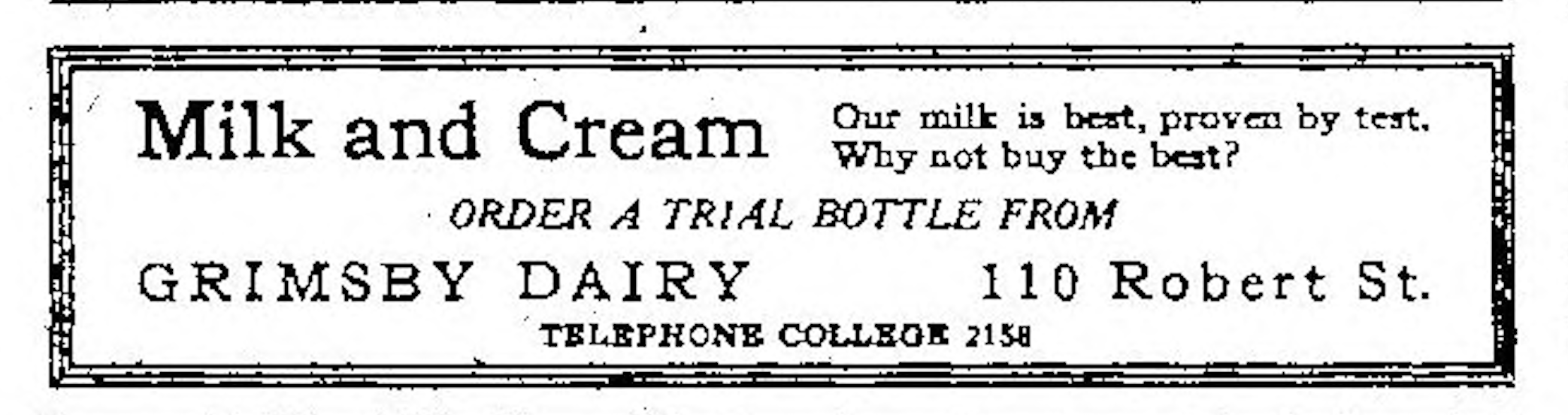
In those days, the city relied on a network of small local dairies (commonly tucked away in back alleys) to distribute fresh milk daily. According to the city’s “Made in Toronto” web exhibit on local food manufacturing, by the start of the century, “Toronto received nearly 20,000 gallons of milk each day from approximately 900 farms within a 40-mile radius, sometimes travelling for up to 36 hours before reaching the consumer.” While the supply chain expanded rapidly to keep up with the city’s growing population, it also required increased regulation, being particularly vulnerable to contamination and market pressures.
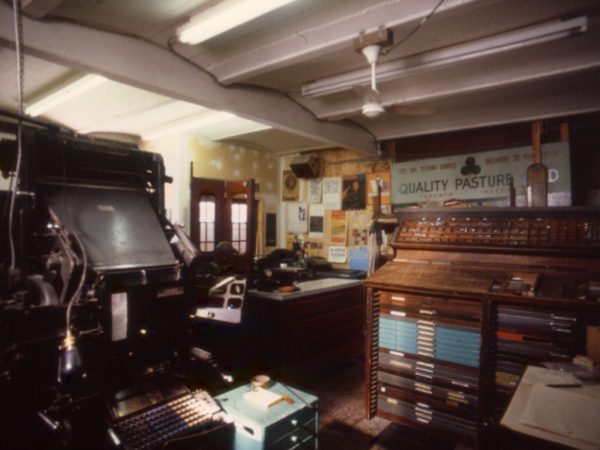
During its active years, the two-storey brick-and-concrete Grimsby Dairy sheltered wagons and horses for milk delivery around the neighbourhood. The ground level, formerly storing the wagons and harnesses, just over half a century later would come to house Glenn’s presses, type, and Linotype machine. A ramp led horses up to the stalls on the second level, which later came to be Anne’s bindery, their living quarters and kitchen, according to accounts from Bringhurst and Douglas Fetherling.
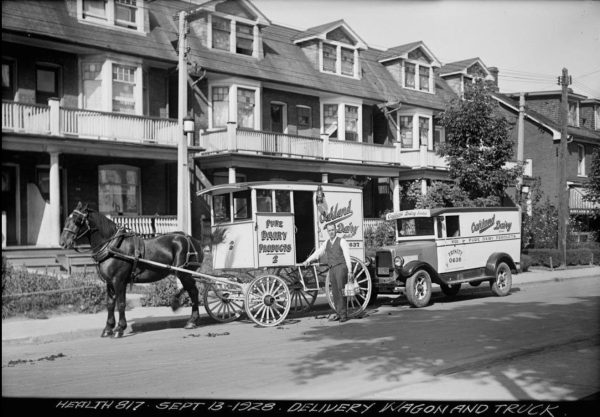
Photograph courtesy of the City of Toronto Archives (Fonds 200 > Series 372 > Sub-series 32 > Item 817).
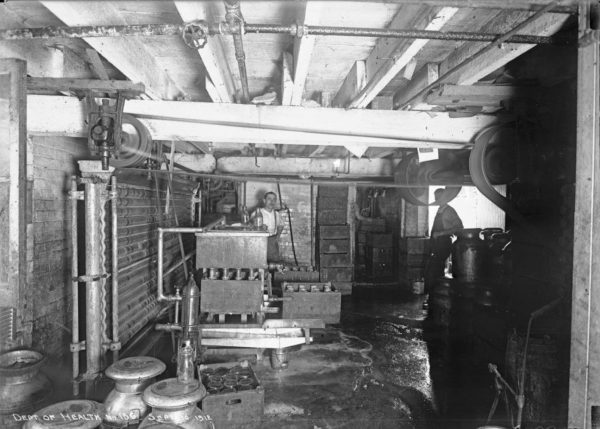
Photograph courtesy of the City of Toronto Archives(Fonds 200 > Series 372 > Sub-series 32 > Item 156).
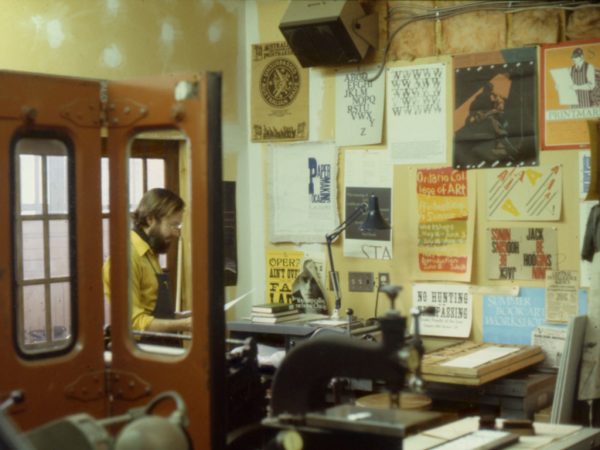
Today, over a century later, passersby can still spot rare remnants of the stable’s original architecture and function, including a metal beam and loop towards the roof on the exterior wall, intended to hoist hay up to the loft through the double door (originally a hay door), as well as metal guards framing the ground-level garage doors, to shield the brickwork from passing wagons and horses.
A couple of oral history interviews conducted by the Harbord Village Residents’ Association (HVRA) in 2013 remarkably record some memories of the dairy. Take, for instance, the anecdote Arthur Zimmerman tells of his mother’s childhood, recalling how her sister would “ride the mares up and down the lanes … for exercise.” Zimmerman’s grandmother, looking out the back window of their home would see his “aunt’s head bobbing up and down behind the fence at the back, riding a horse.”
From what I can tell, no mention of Goluska’s studio or parties come up in the oral history project, and after contacting members of the HVRA, there is limited collective memory of Goluska’s presence in the laneway beyond the printing community.
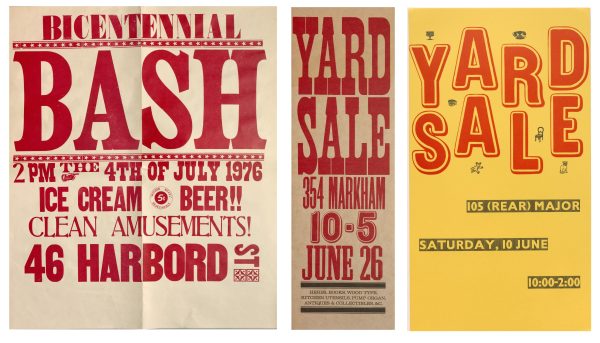
Goluska’s imprimerie dromadaire and the Nightshade Press, alongside Coach House Press and others, model the affinity between print culture and the backstreets, from designing ephemeral neighbourhood signage with a personal and whimsical touch, to reuniting their nineteenth-twentieth century equipment with heritage buildings (and thereby safeguarding both). The printing trade, like the early dairy industry and the Stable itself, has weathered successive waves of technological change. But these crafts, labour histories, and peripheral sites form an important backdrop in our city’s story and reveal enduring lessons around community-building, collective response to emerging technologies, and the value of making (beautiful, quality) things by hand.
Afterword
As I write this, I have just returned from a trip to Nova Scotia, where I had the pleasure of meeting Andrew Steeves for the first time at his Press of the Varying Hare, the newest home of Goluska’s former equipment. Steeves also happens to be the printer commissioned to design the promotional poster for the upcoming Fisher Small & Fine Press Fair, in which playful and colourful letterpress techniques are on full display (not to mention typeset with wood type formerly belonging to Glenn Goluska). A couple of lucky visitors will have the chance to take home one of the 52 limited-edition copies of the handprinted poster to be raffled off by the Fisher Library at the fair.
If any of the above piques your interest, please join us at the Thomas Fisher Rare Book Library on Saturday September 19, 2026. The Small & Fine Press Fair is a biennial event, bringing together some of Canada’s finest book artists to display and sell their works, ranging from bookmarks, cards, and posters to rare, limited-edition handmade volumes. Drop in any time between 10:00 AM-5:00 PM. This event is free and open to the public. See the event page for more information and a full list of participating vendors.
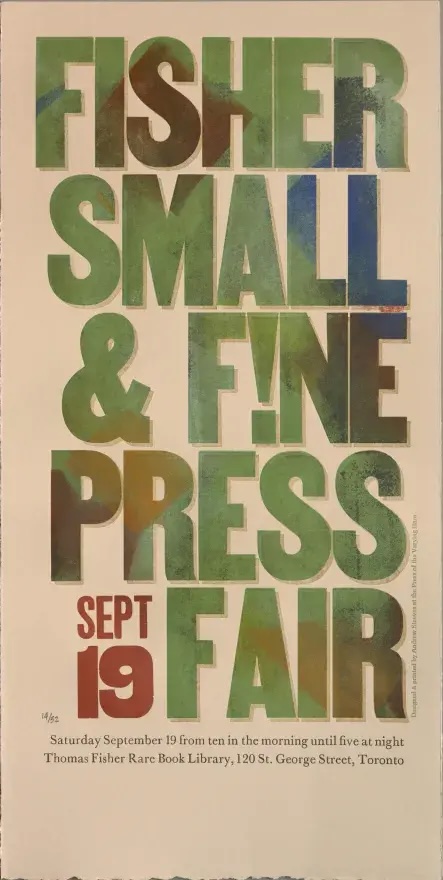
Note: Unless otherwise indicated, all featured imprimerie dromadaire / Nightshade Press imprints were scanned from handprinted originals held at the Thomas Fisher Rare Book Library.
Leora Bromberg is the acquisitions specialist, Thomas Fisher Rare Book Library, and the designer/leader of a new walking tour called Toronto in print.