A few days after last month’s municipal election, Minister of Transportation Prabmeet Sarkaria did a media blitz announcing that the Ontario government had completed removing 1.2 km of bike lanes along Bloor Street West. (He didn’t mention the contractor, Verdi Alliance, whose crews covered their company logos during the work.)
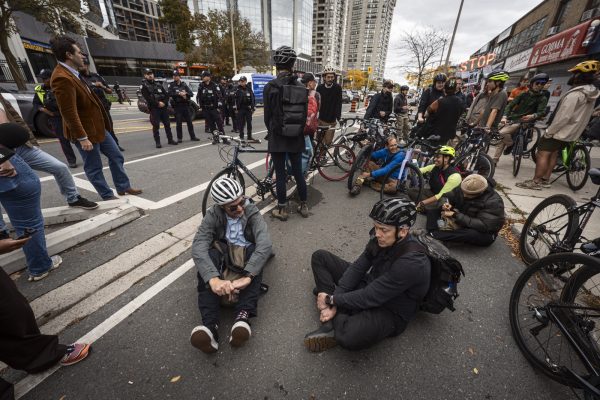
It’s been two years since the province introduced Bill 212, followed by two rounds (to date) of court battles challenging the constitutionality (and logic) of removing bike lanes to address traffic congestion. After two weeks of road deconstruction and protests (and four arrests), we’re left wondering what exactly the government claims it has accomplished.
We have three questions for the minister:
1) Why did the province reject the city’s offer to restore car lanes and keep the bike lanes along Bloor in Etobicoke?
John Moore on Newstalk 1010 called the minister’s appearance “a little gratuitous, it’s like a victory lap for something that was decidedly difficult.” Moore asked about a Toronto Star report in which Mayor Olivia Chow said the minister “walked away” from a compromise to restore traffic lanes and keep bike lanes. Moore asked three times. The minister evaded three times. Ontarians deserve to know why the province refused to work collaboratively with the city.
2) When will the warnings from MTO staff be revisited now that removing these bike lanes could cost Ontario taxpayers $48 million?
Documents released in court revealed MTO staff warned that removing city infrastructure may not be viewed as “the best use of taxpayers’ resources,” and that paying for removals could risk “potential legal action and audit.” The City of Toronto has since estimated that the total removals could cost $48 million — before additional police costs for the almost certain continuing protests. Ontario is now facing a larger-than-forecast deficit. Ontarians deserve to know why elected officials ignored their own staff’s warnings about wasting public money.
3) Who is accountable if the data and expert evidence are right and removing these bike lanes fails to reduce Toronto gridlock?
Replacing bike lanes with car lanes sounds like common sense. Experts say otherwise. An internal memo quotes then-Acting Assistant Deputy Minister Felix Fung saying “there is no empirical evidence that ties bike lanes as the sole source of congestion, (nor) is there data that shows removing bike lanes help with better traffic flow.” The province’s own CIMA+ engineering report agrees: removing bike lanes may increase vehicle capacity, but “the actual alleviation of congestion may be negligible or short-lived due to other confounding factors or induced demand.” Ontarians deserve to know what happens if this unprecedented overreach doesn’t work and traffic doesn’t improve (or gets worse).
“We were elected with a clear mandate to fight gridlock, restore traffic lanes and get drivers moving again,” the minister said in the government’s press release. Toronto voters keep saying otherwise. Former PC MPP Christine Hogarth, who made removing the Etobicoke bike lanes a centrepiece of her campaign, was among the few government incumbents to lose their seat in the 2025 provincial election. In our municipal election, every winning council candidate along Bloor, from Amber Morley to Diana Chan McNally to Mike Layton to Curran Stikuts, pledged to defend the bike lanes. And Olivia Chow won more votes from Toronto voters in her mayoral reelection than any candidate in Canadian history. The province may have won Ontario, but these are Toronto’s streets.
Torontonians will expect Mayor Chow and City Council to use their new political capital to keep putting pressure on the province. Ontario opposition parties, largely silent to date apart from the Greens and a few individual MPPs, must join in loudly and forcefully and stand up for municipal autonomy and against this waste of taxpayer money. Staying silent has only played into the province’s hands, ceding ground as it wedges the suburbs against cities. We’ve previously argued even the federal government should exert soft power to ensure provinces abandon these bike lane schemes.
1.2 km of the target bike lanes are gone. About 18 km remain. Bids for the province’s contract for the removals close in December. And work could resume removing life-saving infrastructure along University, Yonge, and Bloor in downtown Toronto as early as spring 2027.
Minister Sarkaria has his victory. Now it’s about his legacy. He has a choice: ditch the RFP to pursue evidence-based transportation policy, or keep stoking a culture war while commuters remain stuck in traffic.
Michael Longfield is the executive director of Cycle Toronto, a member-supported charity that’s been leading the change for a healthier cycling city since 2008. Cycle Toronto is seeking leave to appeal its Charter challenge to the Supreme Court of Canada against the Ontario government’s attempts to rip out 19 km of protected bike lanes.
Photo by Joshua Best