
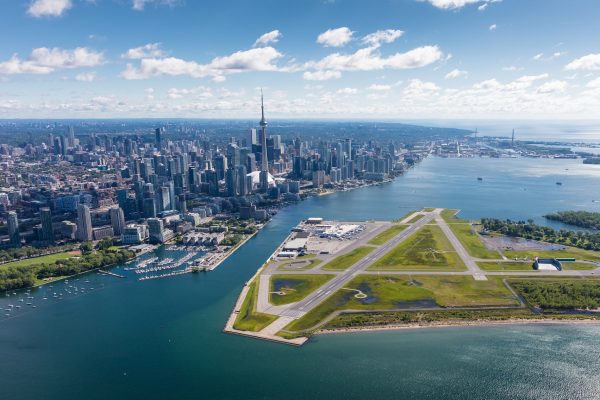
We are City Planners who have spent many years involved in the planning of Toronto’s downtown waterfront. We have also recently chosen to live there. We hope the Government of Canada will reject the Government of Ontario’s plan to expand Billy Bishop. Here’s why:
Through their various governments and agencies, the people of Toronto have invested decades, and vast amounts of money in pursuit of redeveloping the downtown waterfront. As a result, Toronto has emerged as a true waterfront city. A formerly obsolete and derelict industrial zone has been transformed into a thriving and popular recreational district that serves millions of the region’s residents and visitors. It is also a major residential community where thousands of people of all incomes and demographics enrich the area’s unique urban mix. Similar planning and investment dollars are currently going into re-developing the East Bayfront, including commitments to extending the Harbourfront LRT eastward to service the expanding urban waterfront there.
Currently limited to short range aircraft, Billy Bishop Airport positively contributes to that mix. Its usage and infrastructure are in balance with the recreational and neighbourhood uses.
Enabling larger, long range aircraft to use it will, by orders of magnitude, increase the airport’s volume of passengers, flights, and the need for additional transit and parking facilities. As far as we know, there is no plan or funding commitment to improve access to an expanded airport. –
Apparently the province hopes to provide additional parking by expropriating the area and surroundings of Little Norway Park, an important central waterfront amenity that offers beautifully established gardens and a unique baseball diamond.
Moreover, the park is surrounded by hard to replace housing, including affordable rental units, and co-op buildings for disabled individuals and for artists. Immediately to its east is the newly commissioned Irish Memorial and its related theatre, and a local school and community centre. The thought of bulldozing such important public spaces and damaging needed housing is difficult to comprehend, all the more because all the above housing and facilities was made possible by federal government support and financing in the 1980’s kick-off of the re-development of Toronto’s Central Waterfront.
Moreover, the already heavy traffic congestion at Bathurst and Lakeshore Boulevard makes it hard to imagine much improvement to vehicular access. Similar is the case for public transit. The airport is currently serviced by the Bathurst streetcar, which terminates at Fleet Street, and the Harbourfront LRT, which is accessed at Queens Quay West. Extending these lines south to the airport terminal would be expensive and disruptive while providing only marginal capacity improvements relative to greatly increased demand.
In summary, this radical proposed expansion of the airport will create order-of-magnitude increases in demand for access infrastructure that will be difficult and extremely expensive to meet.
It also risks wiping out the pleasure enjoyed by millions of Canadians, and rendering wasted the human, political, and financial resources that have gone into waterfront rejuvenation.
That prospect is cause for alarm. The concern is not just about jets or noise. It’s about radically shifting the delicate balance on Toronto’s downtown waterfront and compromising its quality as a unique urban asset.
The question we’re asking is why? Access between downtown Toronto and Pearson International has been greatly enhanced by the UP Express, bringing Union Station within 20 minutes travel time of a major hub airport.
The enormous expansion of the GTA has also shifted the demand for airport access to a far broader distribution of origin points, dwarfing the downtown need for additional airport access.
We suggest that future federal and provincial investment in supplementing Torontonians’ access to air travel be directed to responding to regional shifts in airport-bound demand and further improving operations at Pearson.
Ron Soskolne and Howard Cohen were senior city planners during the 1970’s, and principal co-authors of Toronto’s Central Area Plan. Howard headed up the original creation of Harbourfront, and went on to found Context Development. Ron headed up planning and development for a Toronto based development company, completing large waterfront complexes in London, New York, and Toronto. He subsequently served as as a consultant to the city, stewarding the development of Yonge Dundas Square.
3 comments
While this article seems simplistic in nature, glossing over what is actually happening. As mentioned we don’t actually know what is going to happen and any resulting theorizing is projecting. How different is this from when Porter first started flights and we were told it would be a disaster?
I constantly find misinformation on the side against the airport: Please look up the schedule and tell me which UPX train gets you to Union within 20 minutes? It’s not true. According to Toronto city staff most origin/destination for the island airport are within 5 km (as far as Davenport and Bathurst). This means that by the time you get to Union to go to Pearson, you would likely already be waiting in the security line at Billy Bishop airport.
ANy talk of theorizing should be reserved for the present Premier. He has claimed 8 billion in economic activity to be generated by this proposal. How is it possible to claim any benefit when he doesn’t even have a plan? I can almost certainly detail a considerable loss of value to local housing, increased cost for travel, degradation of the environment. The Premier is a grifter. We showed that his plans at Ontario Place would be a loser and we were right! It went from a 400,000 dollar embarrassment to a 2.2 billion dollar boondoggle (and counting). If the Premier can dream in techno colour we can certainly be allowed skepticism.
Travel time from Union to Pearson is advertised as 28 minutes. It is not necessary to go to Union Station as you can pick up the UPX from the LIne 2 Subway (Dundas West Station) and Bloor GO Station (17 minutes), plus Weston GO Station and Line 5 Eglinton Crosstown (11 minutes). There is the TTC’s airport Rocket from Kipling Station, which I have taken many times in under 20 minutes. Obviously that last one depends on traffic. If you want to improve travel to the airport, Metrolinx should consider a shuttle bus from Malton GO to the airport (8 minutes), which would eliminate the need to drive to the airport for people as far west as Kitchener.
I recently went from College and Ossington to the Billy Bishop airport to pick up a rental car. On a Friday afternoon, it took me 35 minutes by Lyft to go the 3.9 kilometres, an average speed of about 7 km/h through traffic. The up escalator in the tunnel was out, necessitating a 10-minute wait for the ferry. The tiny drop-off area a BB was jammed.
It’s impossible to see how this airport could be reconfigured to serve ten million passengers a year without destroying the waterfront. Or if it was, how anyone would ever get to it.