
One of my urban detective sessions: browsing through well-known New York City neighbourhoods famous for having changed, like Williamsburg and Greenwich Village. Taking Google Street View back to the earliest documented year available, I went looking for and following evidence. I was travelling along Bleecker Street when I found the caricature transformation story I had heard of before. Street View turns that curiosity into a method: scrolling back through years to read time on a single street, address by address, year by year.
Everything that follows is observed from Street View images alone. Come with me on a little detective story.
Bleecker Street
Here is what the photographic archive shows at 239 and 241 Bleecker over fifteen years, told in six beats.
1 – Baseline (pre-2013)
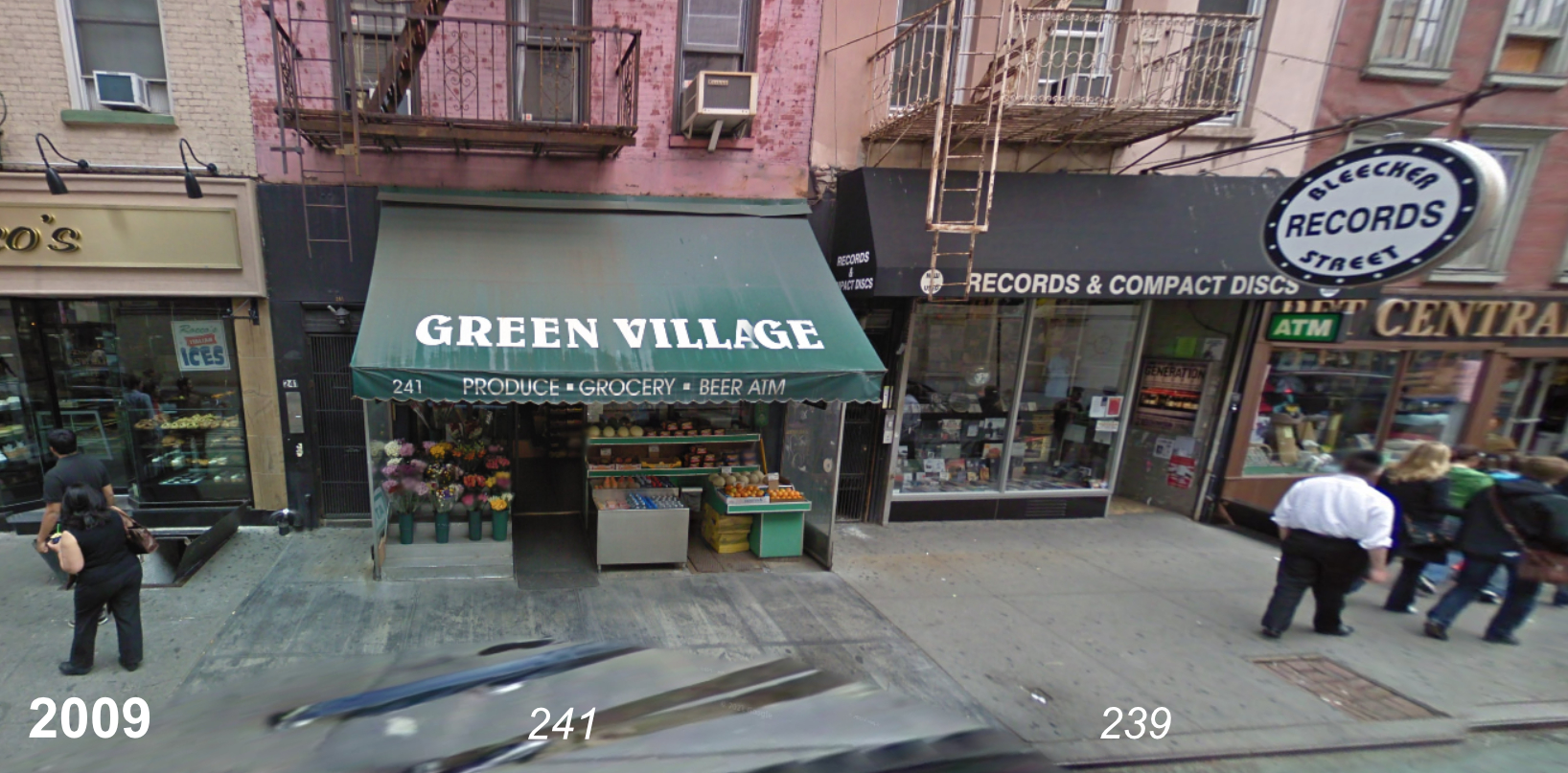
241 Bleecker Street, Greenwich Village, a produce shop: Green Village, ordinary and functional, the kind of place a neighbourhood runs on.
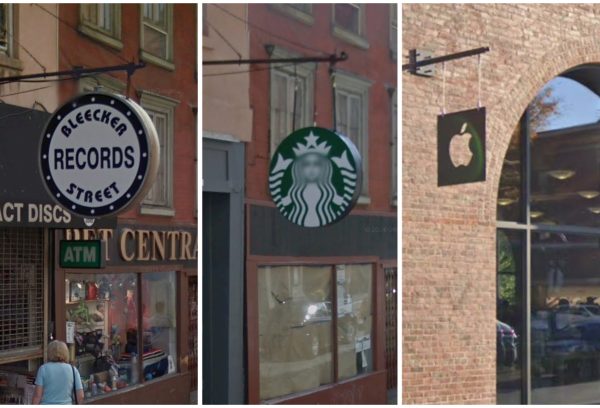
Next door at 239, a record store. Bleecker Street Records: a circular hanging sign, bold black and white, the kind of sign that feels like it has stories to tell.
2 – Out with the old (2013)
241 — the produce shop left, and no forwarding address was left with it. A for-rent sign appeared in the window.
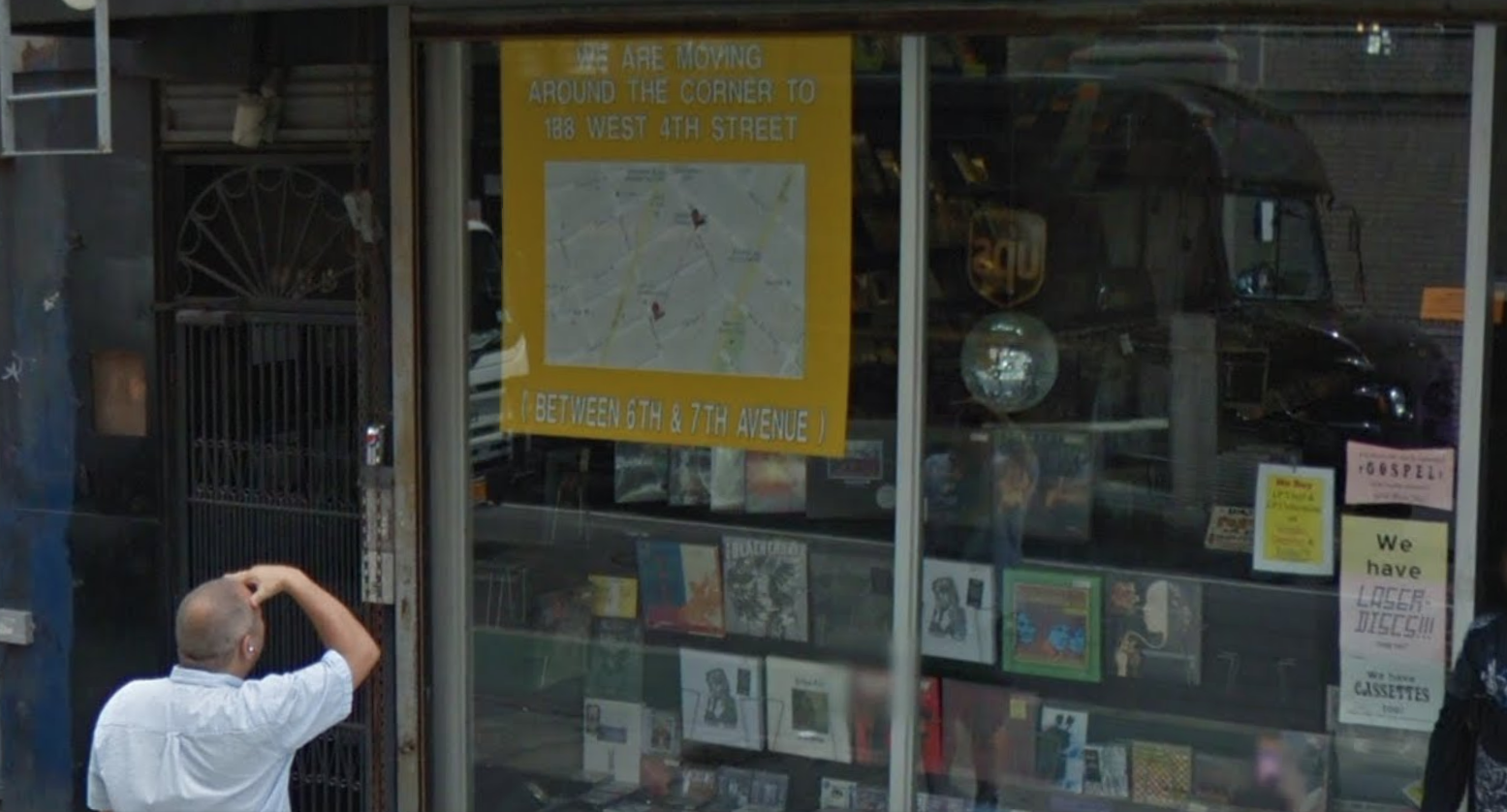
239 — a sign in the window of the record store with a small map pointing to a new address on West 4th Street. Of course I followed it; the archive lets you. I found it. It survived the new location for three more years before disappearing entirely, and eventually absorbed into the restaurant bar expanding from next door.
3 – The caricature arrives (2014)
241 —Carré d’Artistes art gallery moved in, the original grocery store glass frame intact, a simple sign stretched above.
239 — Starbucks arrived. The usual suspect. The literal caricature, confirmation bias right on schedule. But look what I found: the circular hanging sign had its second life, now bearing the iconic mermaid, up in the same bracket position where the record store sign once hung. Same format, same gesture. Whether this was conscious or coincidental, the archive cannot say.
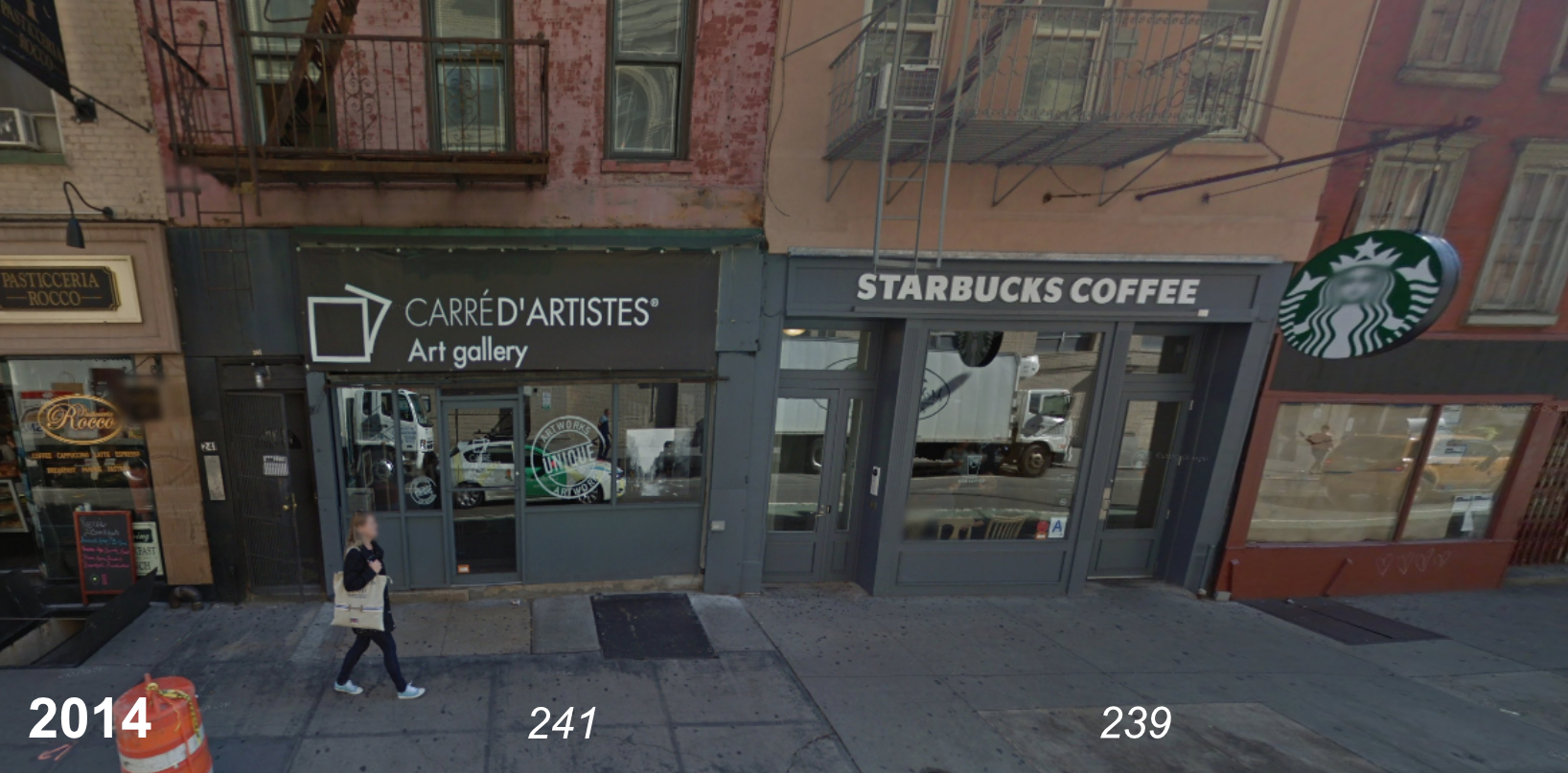
4 – The new normal (2014–2020)
241 —By 2017, the art gallery glass had been replaced, cleaner and more visible, the fonts in the signage above refined, the literal definition of an upgrade.
239 — Starbucks, now firmly settled in as if it had always been there, right next to a mobile provider (Verizon)
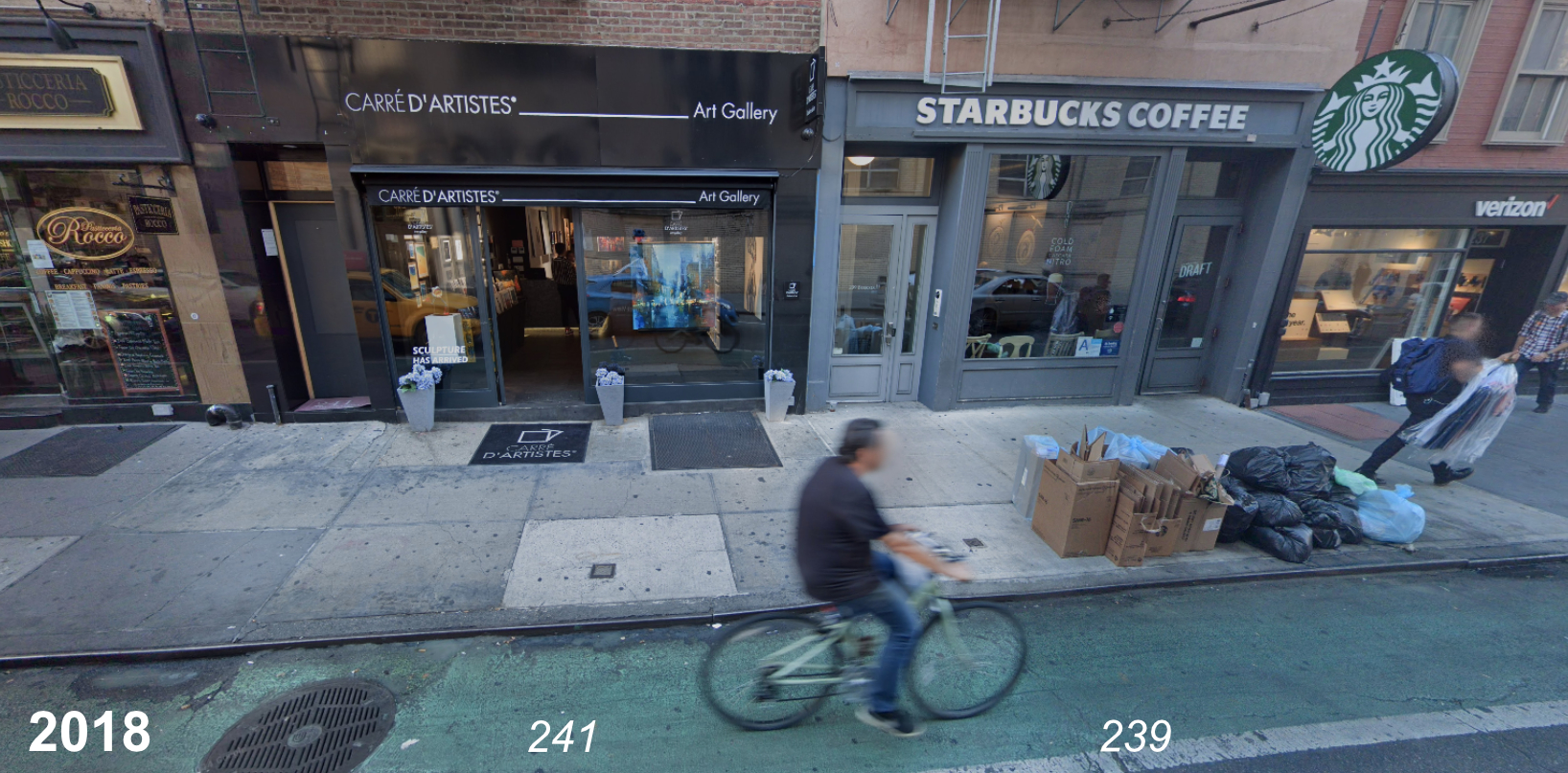
5 – Restart (2021–2024)
241 — A trendy-looking shop selling e-scooters in 2021. By 2022 Players Cafe opens, glowing lottery signs visible through the window.
239 — COVID. Starbucks closed. A map of nearby Starbucks locations posted on the door on the way out. After a period of vacancy, in 2024 The Nut Factory, a fancy nut shop briefly appeared.
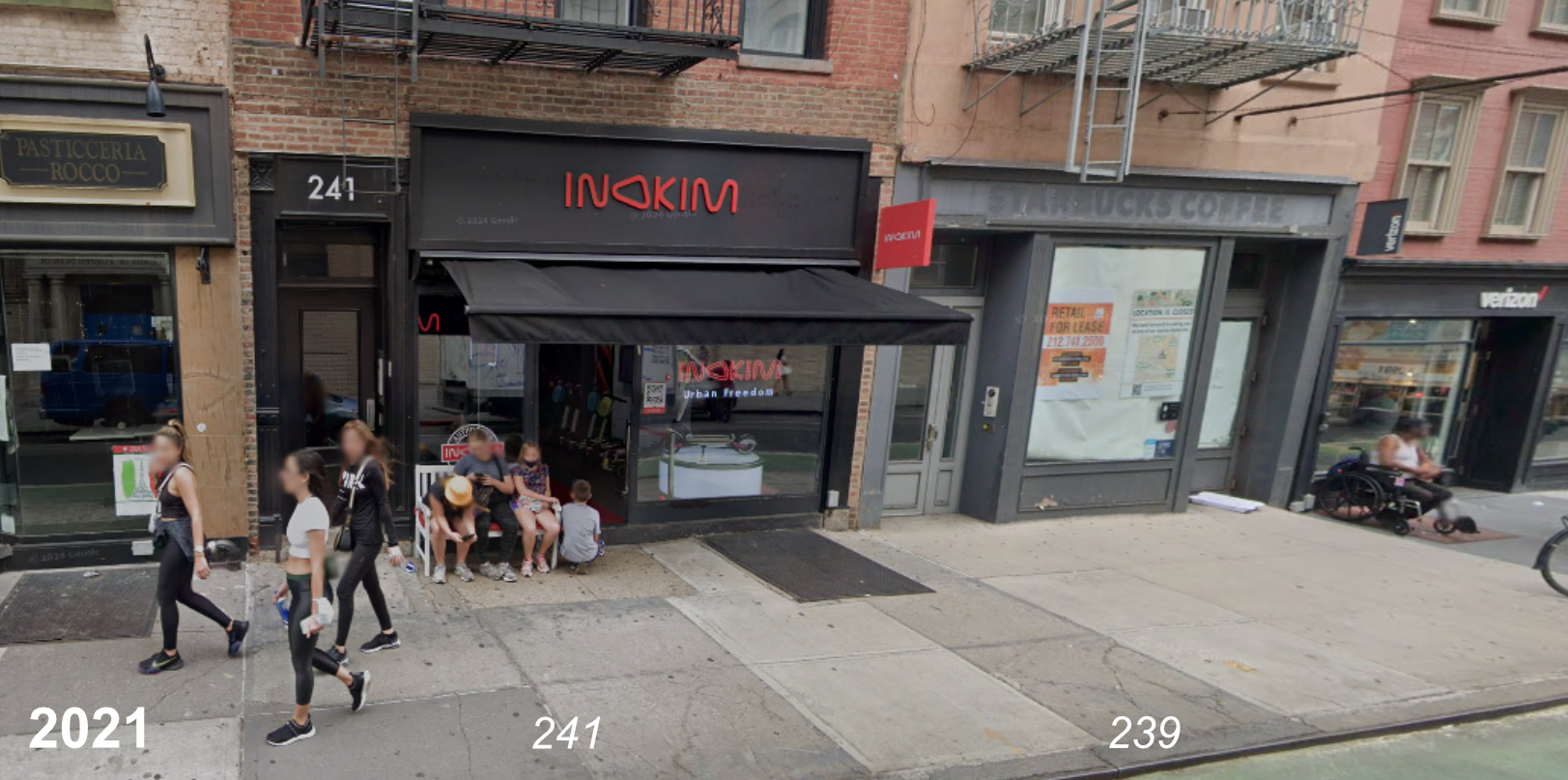
6 – As it stands (2026)
241 — Now, with a more franchised uniform-looking signage that says “LOTTO.com” in large letters, and Players Cafe beneath it.
239 — Ten Ichi Mart and Deli, Japanese groceries. Full circle, right next door to 241, where the produce shop once stood, unaware of any of it.
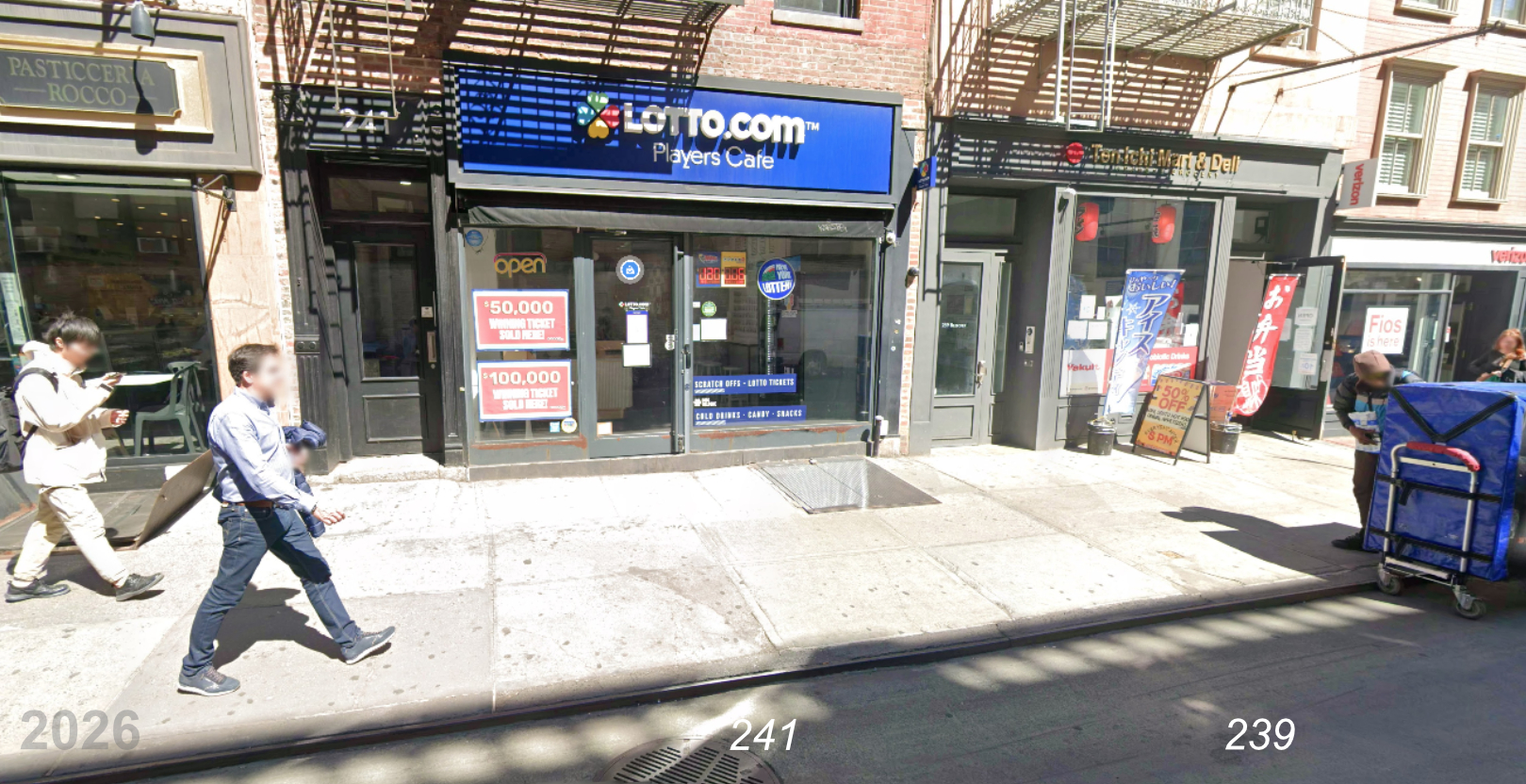
Street View unleashes a sequence of events when you follow it year by year; stretch that view over a decade or two and patterns begin to unfold, with Bleecker as just one revealing case.
Now hop on the subway, take the L to Bedford Avenue.
Bedford Avenue
Get off at Bedford Avenue and walk along the east-side sidewalk. Here is what the photographic archive shows at the L‑Station corner and at 247 Bedford over the years.
1 – Bedford and L Subway
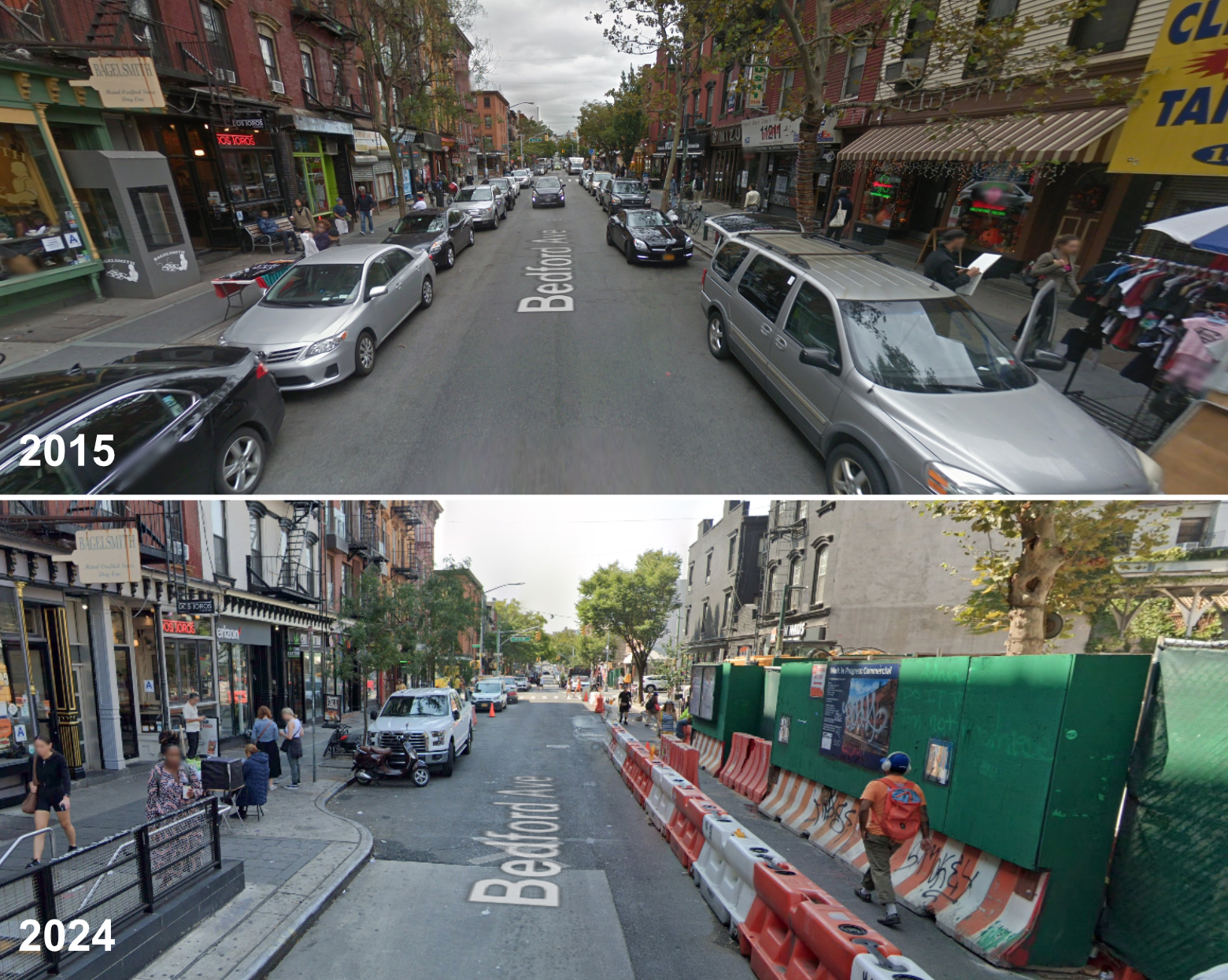
Step out of the station and land on Bedford itself. In the most recent image, a subway entrance opens onto the sidewalk, a widened pavement swooping toward it. Shifting the time bar back, that exit is the first notable thing missing in the pre‑2017 images. Parked cars line the curb lane, while the older station entrances remain around the corner.
Bagelsmith sits immediately to the exit’s left, and its sign and windows keep reappearing from the first year the archive offers (2007) to the latest one, while the shops on either side cycle through different colours and names.
The street reads as a complete scene: people moving past the shopfronts and along a row of restaurants and small stores, with aligned trees and characteristic brick buildings. In the 2024 image, the continuous row of buildings on the right side is gone, replaced by a construction site with temporary barriers along half the block.
Zooming in on a sign on the hoarding reveals a rendering of a low brick building with tall arched openings, marketed as prime retail across from one of Williamsburg’s busiest stops. A quick check of local development news and a more recent angle confirms both the anticipated architecture and that the new building is already complete.
2 – Bedford and Apple
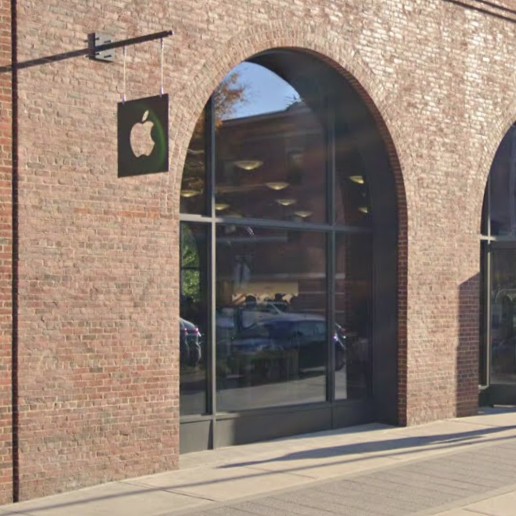
Continue walking four minutes along Bedford. At 247, a small dark square hangs from a metal bracket over the pavement, fixed to a facade of clean brick and repeating arches. Looking closely, the Apple logo is distinct, floating quietly against the brick wall, and when the sun is out, its shadow projects the logo onto the brick a second time.
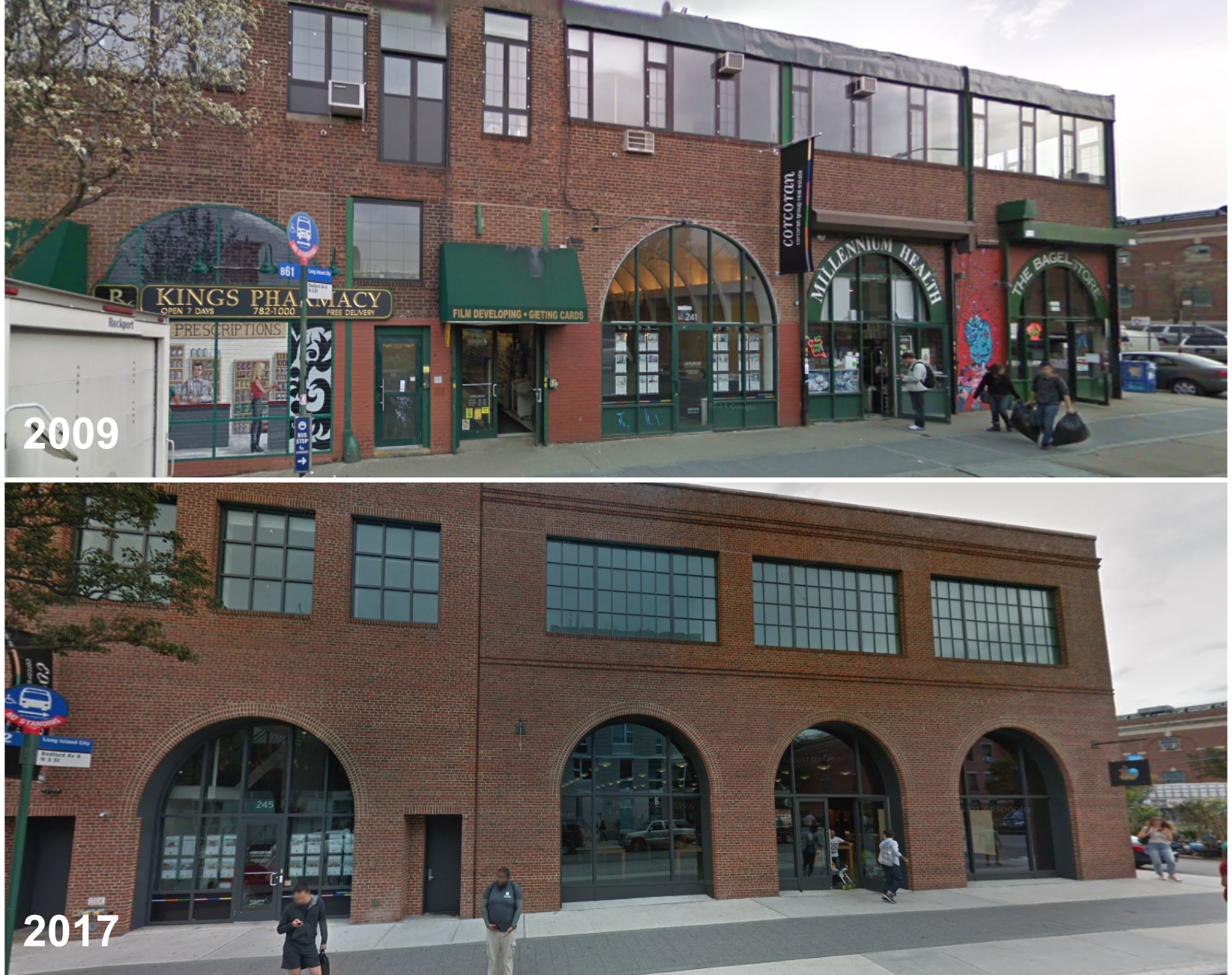
Scrolling back through earlier years at 247 Bedford, 2009 shows a building with character: three unmistakable arches, each with its own tenant. The corner bay houses The Bagel Store (yes, another bagel on Bedford), the next arch is a health store, and a real estate agency in the third. By 2012, faded handwriting on the middle storefront glass announces it has already moved on, and by 2014 the remaining two are boarded up and ready for construction.
Jump ahead to 2017 and at first glance the arches seem unchanged: same rhythm, same proportions, the same warmth. Look closer and the details do not quite line up. This is not a renovation, it is a complete new build: a near replica of the original brick structure, a brick skin wrapped over a steel frame constructed from scratch to meet Apple’s needs.
Replicating “Character”
What people call a street’s “character” is somewhat intangible, yet it is built out of very tangible pieces: the architecture, the materials, the specific mix of people on the streets, the kinds of tenants that inhabit it, and the ways they choose to announce themselves. Together, their repetitions and variations add up to what we read as the character of the street.
In Bedford, there is just a small fruit‑shaped icon cut out of a metal plate, almost too quiet for a global company. It echoes the Bleecker Starbucks mermaid on the same hanging bracket where the record store sign once stood. In both cases, the hanging sign does double work: marking a tenant and signalling the story the street wants to tell about itself, its character.
Bedford doesn’t come without judgment. A brick‑and‑mortar version of one of the biggest corporations in the world sits just behind the surface, its restraint deliberate and announced only by a miniature, carefully placed sign: not shouting, almost non‑branding, no store name to be found, just a small sign hanging graciously.
The authenticity has been replicated through architecture, through brick and mortar. While Apple Bedford reaches back to the past to bring its physical dimensions and feeling into the future, the new L‑Station Bedford does not reflect the earlier architecture of its site. It replaces a run of older buildings that had variety and texture: different heights, uses, materials. In their place, the new volume seems less about adding homes or real density and more about creating room: large, clean floors made to receive global brands.
What Apple tried to replicate in brick and arches may have quietly become the business model for the street’s future. The “authentic” Bedford being replicated here is not a return to some original state but an imaginary earlier street, reconstructed to fit current tastes and set in brick. The search for authenticity is not incidental to this process; it is the engine of it. In Naked City: The Death and Life of Authentic Urban Places, Sharon Zukin documents how the character of a neighbourhood, its rawness, its history, its imperfection, becomes the very thing that attracts what eventually replaces it.
If Apple Bedford is a replica of its own idea of Bedford’s past and its imagined character, then the new L‑Station Bedford feels like a replica of that.
Identifying the pattern
Having investigated both Bleecker and Bedford imagery over a period of almost two decades, one thing is clear: constant transformation and cycles of renewal. Not just new buildings and new tenants, but shifts in who the street is for, how “local” gets interpreted, and what happened to those who were there before. So, what are we actually seeing here?
Gentrification is one of those catch‑all terms, applied to a record store closing and being replaced by a Starbucks, to an art gallery that replaced a grocery store, to a corporation replicating the arches it demolished, or a new unaffordable residential building. The same word covers all of it, which is part of why it is so hard to visualise cleanly. It is also a word people interpret based on their reality: while some see known brands as drawing new life to a street, others see them pushing out what was already there.
Phillip Clay mapped the sequence in 1979. In Neighborhood Renewal, he identified four stages: pioneers first, drawn by cheap rents: artists, bohemians, the creative class. Then the middle class follows, then displacement as values rise, and finally mature gentrification, the neighbourhood fully turned over to capital. The art gallery at 241 Bleecker, almost to the letter, is the pioneer stage. The Apple store at 247 Bedford accelerated straight to the mature stage.
When I first documented the Bleecker images for a visual series, the story felt complete at the Starbucks closing, a tidy arc. Since then, the archive kept going, and the story continued. In the archive, each change is a fact: a building demolished, a shop gone, another tenant arriving, unaware of what came before. The yearning for authenticity will keep expressing itself in different ways, sometimes hidden in the details. When those moments are sequenced over time, their echoes become visible, and that is where identifying the pattern happens. Exploring address by address, year by year, the fine grain of urban conditions renders itself in greater resolution, challenges assumptions, and is surprisingly rewarding.
What is the Bleecker and Bedford of your city? Some detective work will uncover more than you expect.
***
Yuval Fogelson is an urban designer, educator, and artist who loves to explore and understand cities. Based in Vancouver, his work spans the built environment, from public space transformations and tactical urbanism to mobility hub networks and digital twins. He is the founder of YF City Urbanism and paints maps as part of Yellow Future City.