
In today’s city, information and experiences find you and appear on your screens, yet the human craving for physical presence still pulls us out into the city. Words like ‘reel’, ‘short’, and ‘feed’ are very much of this moment. If they date this article about the present, that is only fitting.
The Reel is Real
A fifteen-second reel of a trending cube croissant from the raved about deli off Piccadilly, London hits your feed. You watch someone document their experience as they wait, order, and finally take a bite, do the expected facial expression, and look like it was absolutely worth it. You share it with a friend. Next thing you know, you are tapping your Oyster card at your local tube station, exiting at Green Park, and joining the queue that goes around the block. The reel gave you everything except the one thing it could not: the bite itself.
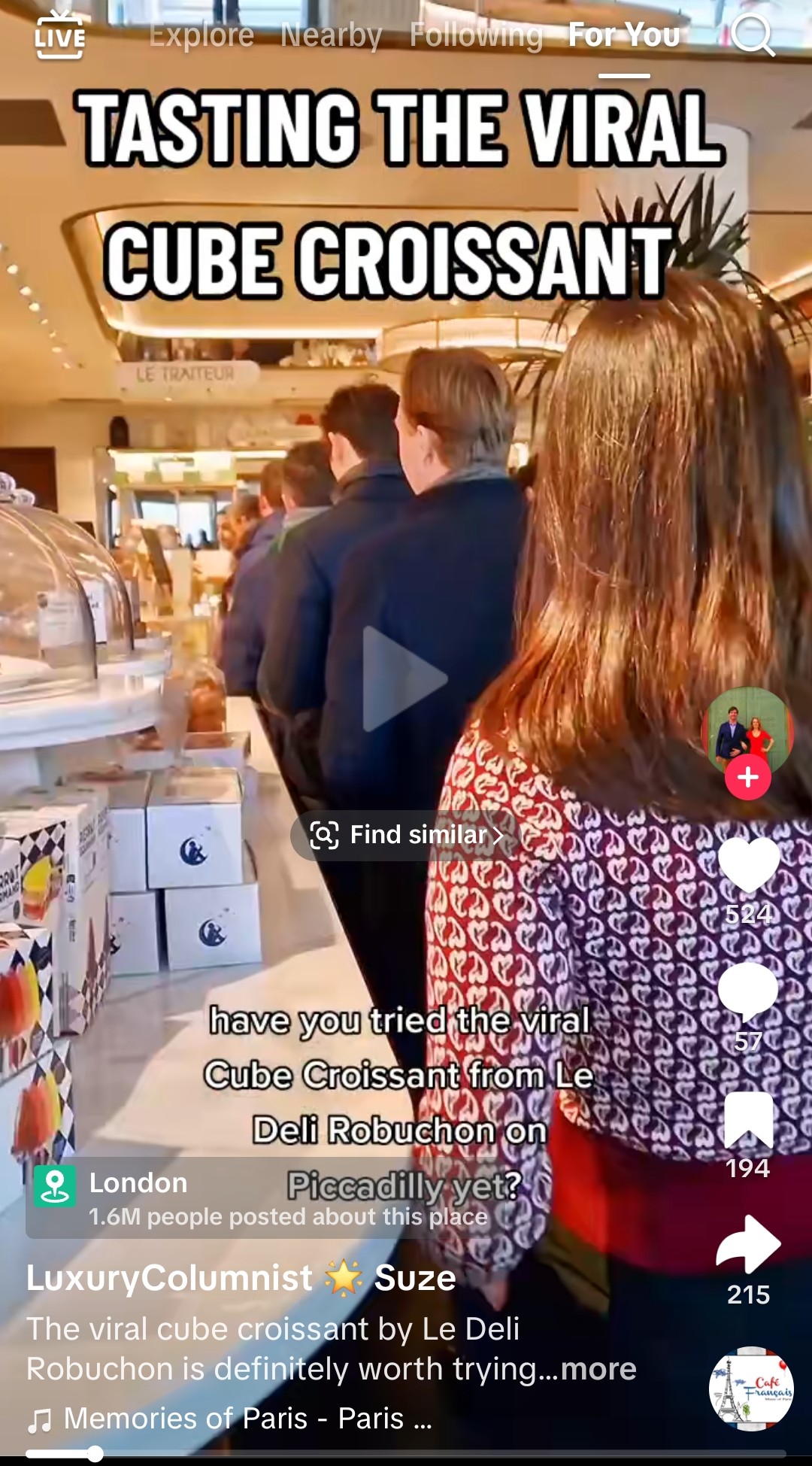
The city provides the scale that makes this possible. A viral signal reaches millions. A fraction can imagine eating that cube croissant. A fraction of those live within reach. A fraction of those have a free afternoon. A fraction of those are willing to queue. The city is where enough people exist at the end of that chain to make the queue real.
Once the queue exists, it spreads differently. Someone walking past sees the line and stops. What’s this? Haven’t you heard? They join. The queue grows, the virtual signal becoming a physical one, the queue itself now doing what the reel started. Local news picks it up and the next day more people arrive who never saw the original reel. The wave builds, and eventually breaks. A few months later, no queue. In the grand scheme of things, the hype was just a moment. A business that rides a wave like this can find itself on the map in a way it was not before. The hype clearly left its tracks.
The Pull of the Physical
Word of mouth has long sent people to specific places in the city. What has changed is the targeted reach, the speed, and something else: the intention. People make decisions on how to spend their time and money through a pre-vetted flow, arriving with their minds already made up, rather than spontaneous discovery.
Paradoxically, as the virtual has grown more saturated, the physical city has not retreated. After years of curated feeds and polished experiences, people are craving in-person gatherings that feel less choreographed and more real. The gathering, the market, the concert, the public event. All are being sought out with deliberateness. The body in the city, in a shared space, at a specific moment, is the one thing the feed cannot give you.
The city makes this possible. A viral signal reaches millions, but only in a city are enough people within physical reach that a significant number actually show up. The queue around the block is not just a transaction but a temporary community of strangers who all saw the same fifteen seconds and made the same decision. They did not know each other before the reel and will likely not meet again. For a moment on the pavement outside a bakery in London, they share the same present.
The Pulse of the City
Batty, in Inventing Future Cities, describes what he calls the high-frequency city: the collective of pulses firing at different rates, visible only through real-time digital data. London’s transit system is one example. Every Oyster card tap, including the ones getting off the tube at Green Park for a cube croissant, maps exactly how the city moves throughout the day, which stations surge at rush hour, which empty by midnight. CCTV captures the street continuously. Mobile phone signals track the movement of crowds. Sensors embedded in infrastructure record load, temperature, flow. The city’s rhythm is now continuously documented.
When something disrupts that rhythm, it becomes visible in real time. When a signal fails at a central station, within minutes the flow of thousands of people shifts, backs up, redirects. Transport operators see it on screens before most passengers have worked out what is happening. Alternative routes get communicated. The network absorbs the disruption, or it doesn’t. Either way, the present condition of the city is legible as it unfolds.
What this also means is that any moment in the city can be revisited. Not experienced again, but examined. What was the condition on this specific place on that specific day and time stamp? The question can now be answered. A present that once existed only for those who were there has become permanently accessible.
Manhattanhenge
The name is Manhattanhenge, a reference to Stonehenge and its solar alignments. It appeared in my feed as it was occurring while I was writing this article. Twice a year, the setting sun aligns precisely with Manhattan’s east-west street grid in New York. For a few minutes, the light cuts straight down the cross streets, flooding the canyon between buildings with a corridor of gold. Crowds gather on 14th Street, 23rd, 34th, 42nd, 57th. They face west. They wait. Then it happens, and then it is gone.
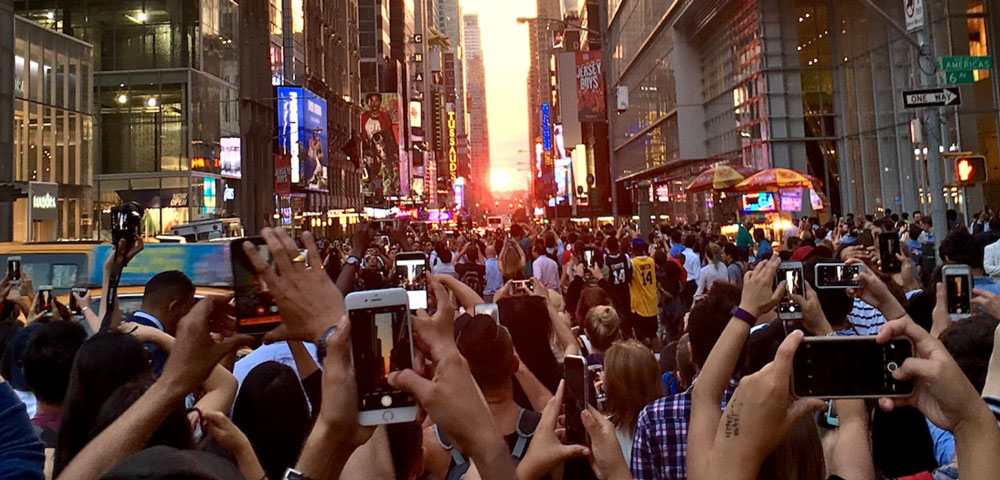
Manhattanhenge is not the result of deliberate design, but of the way Manhattan’s grid was laid out in 1811 by the Commissioners, dividing an island into lots that could be bought, sold, and built on. They oriented the grid approximately 29 degrees east of true north, for reasons of real estate and navigation. Today, people stand on those streets with cameras raised, waiting for a moment that lasts a few minutes, standing in the consequence of a decision made long before the megacity emerged. The 1811 grid did not know it was creating Manhattanhenge. It was creating property lines.
Go to 42nd Street on any other evening, and you will find a street. Go on the right evening in late May or mid-July, at the right minute, and you will find something cosmic. The same coordinates, the same buildings, the same grid. A different present. One that only exists because of a specific alignment of the sun, the earth, and a planning decision made two centuries ago. That is the cosmic present.
One Place, One Time
Step back from the sun. Shift dimensions, from space to time. Universally, time stretches from past to future. The past exists only in memory. The future exists only in imagination. The present is the only tense you can bite into a croissant, tap a card through a turnstile, or feel the sunlight cutting through a canyon of buildings at exactly the right moment.
***
<< The Pasts of the City | The City in the Present | The City and its Futures >>
***
Yuval Fogelson is an urban designer, educator, and artist who loves to explore and understand cities. Based in Vancouver, his work spans the built environment, from public space transformations and tactical urbanism to mobility hub networks and digital twins. He is the founder of YF City Urbanism and paints maps as part of Yellow Future City.