
The future seems far, abstract, and fuzzy, yet sometimes it’s right there in front of us.
A Sign of Things to Come
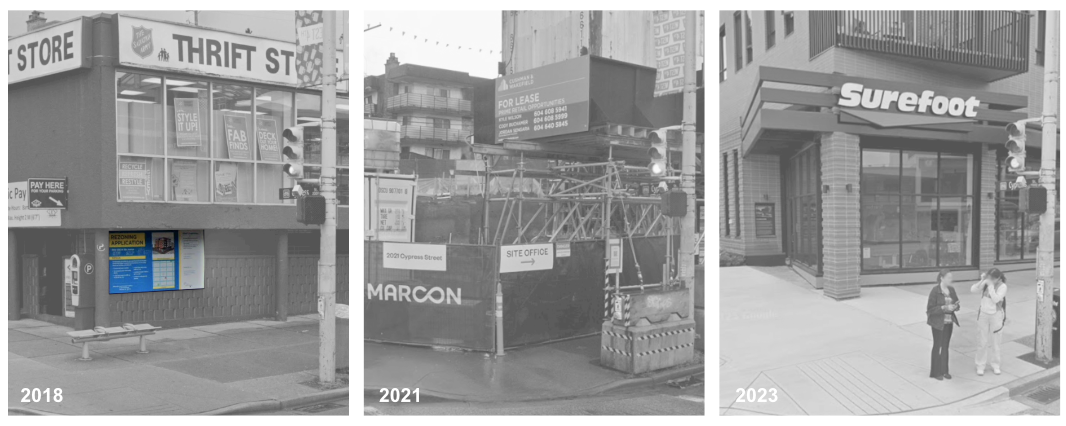
Walk past a building marked for redevelopment and you might find a large sign mounted in front of it: a render of what is coming, a proposal for what will replace what is still standing. Residents enter and leave, a cat sits on the windowsill, a delivery stops at the door. The building is what it has been, and yet it is already haunted by what it might become. The future has been printed and posted in front of the present.
Most people walk past. Others graffiti over the render in protest, questioning its scale, its relationship to the street, the kind of city it represents, who it is being built for. The future announced on the sign does not arrive without controversy.
The future announces itself at different stages. The rezoning render posted on a fence. The construction hoarding promising something new on a cleared site. The towers rising floor by floor, the skyline already shifting before the work is done. At each stage, two timescales coexist: what is here, and what is becoming.
Multiple Futures
Every future is really many futures, a spectrum of possibilities that widens and multiplies the further out you look. The closer to today, the narrower the range of realistic outcomes. The further ahead, the more opens up, in every direction.
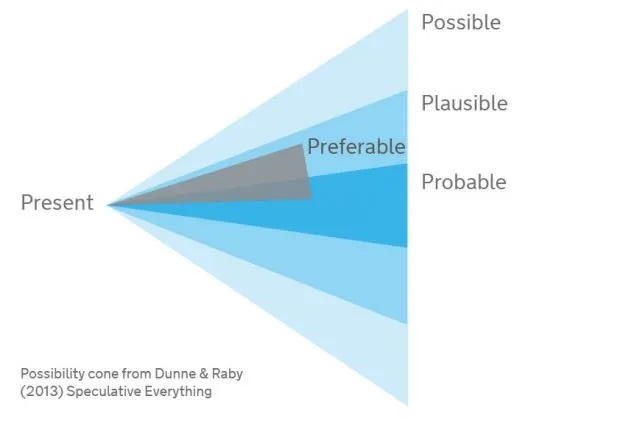
In Speculate Everything, Dunne and Raby map this spectrum as a cone widening over time from the present. The probable sits narrowest: the most likely trajectory if little changes. The plausible extends further: outcomes that could emerge under different conditions. The possible reaches the outer edge: things at the limit of what we can currently imagine. The preferable sits as a wedge angled toward the desirable: not the most likely future, but the most worth working toward.
Working with the full spectrum means creating multiple ‘what if’ scenarios for the long-term vision on the horizon, not only the ones we hope for, but others too, including the ones we want to avoid. Seeing what to avoid is as clarifying as seeing what to aim for. Out of this exploration, one or more long-term visions emerge, not as fixed destinations but as guiding principles to orient the path.
The gap between today and those visions is significant, often difficult for the imagination to bridge. People have real difficulty imagining the long term, even when that future falls comfortably within their own lifetime.
Start from the Vision and go Backwards
The long-horizon vision, the preferred future at the edge of what we can credibly imagine, twenty, thirty, fifty years out, is the starting point, not the end point. The goal is not to predict whether it will happen. The goal is to use it as a guide. Working backwards from that vision, a question emerges: what needs to be true for this to be possible? The vision does not have to be binding to be useful. It simply needs to be clear enough to give direction to decisions being made today.
Norway set a long-term vision: that eventually, all new cars sold should be zero-emission. The pathway backward revealed what needed to be in place first. Toll exemptions, tax incentives, expanding charging infrastructure. These were not the destination; they were the steps that made it reachable. Today, Norway has practically achieved that vision. With it, the incentives have begun to be retired, as they are no longer needed. What was once a future that other countries could only imagine has become Norway’s present. The new normal.
Any vision faces the same test: the pathway from the future does not close on its own. Without equally deliberate steps forward from today, the vision and the present may never meet. Backcasting gives direction: arriving there requires working from the other end too.
Start from Today and go Forward
The other direction begins today, with the question: what are the next actionable steps within the constraints of the present moment? These are physical changes, quick to implement, possible to observe and monitor, capable of generating real insights into behaviour before any fixed outcome is committed to, and reversible. They are not one-off events for the sake of neighbourhood activity, but interventions designed with the next stage clearly in mind.
Following tactical urbanism, this approach moves through steps of increasing permanence, each one generating information on how people respond to change in a specific place as it’s being piloted. Each intervention plants a seed of change, building the momentum that might not otherwise exist to move from the tested and proven toward actual implementation.
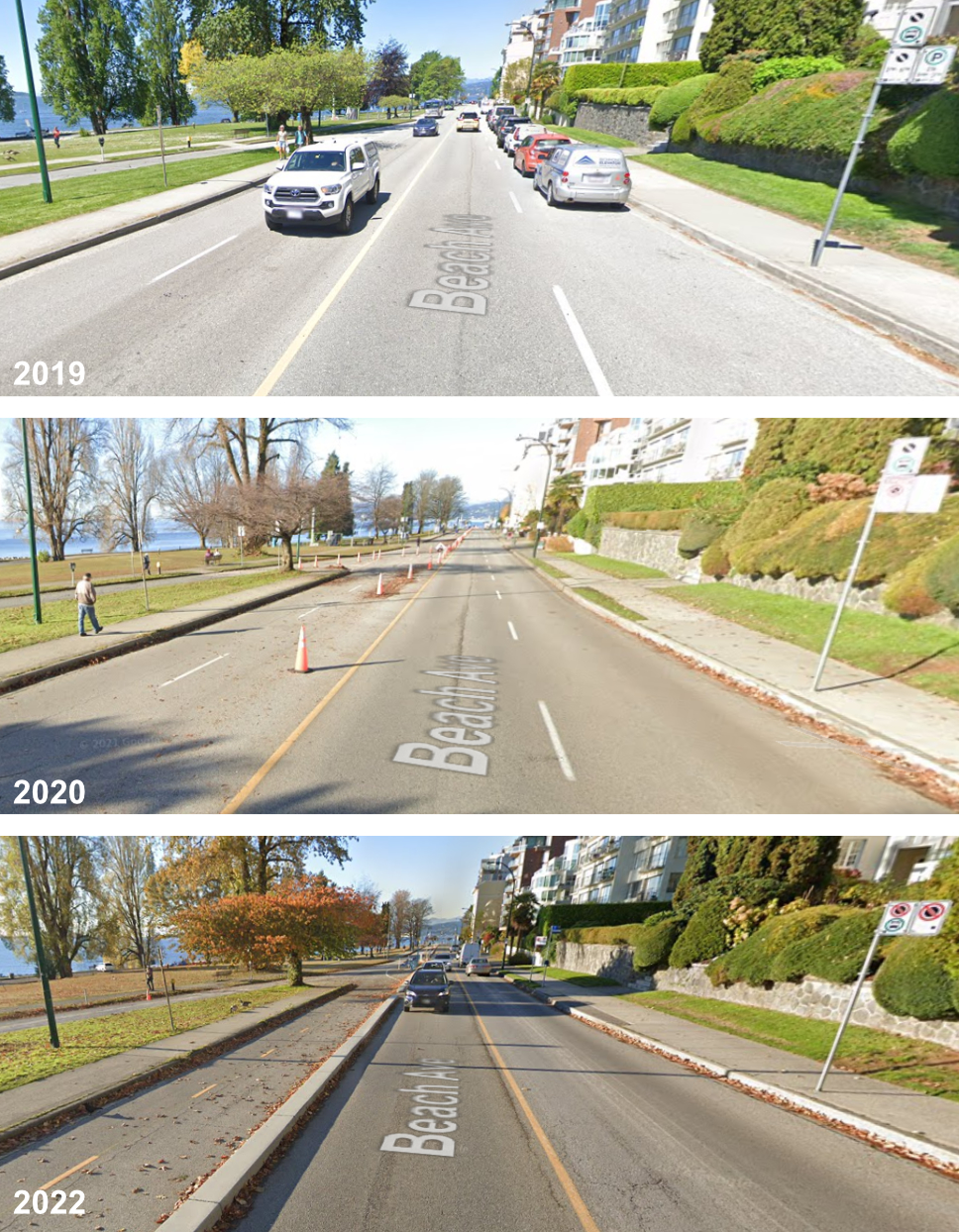
During the pandemic, a lane of Beach Avenue in Vancouver was temporarily designated for a two-directional cycling way. The existing seawall route below was previously shared between cyclists and pedestrians, joggers, rollerbladers, people wandering slowly meandering along the water, with the friction of fast and slow movements. Beach Avenue offered a straight, flat, uninterrupted line for cycling, removing that friction entirely. It started with cones. Then bollards. The two-directional cycleway stayed, and with it, the seawall became a more purely pedestrian space. Some changes need a spark to ignite. A reallocation that might have taken years to approve under ‘normal conditions’, was tested, observed, and made permanent in months.
From my own experience leading tactical urbanism interventions, the ones that become a lasting reality rarely do so on their own. They tip over only when the right conditions align: the right political moment, the right organizations behind them, and nothing controversial enough to unravel what was built. The concretized version of those interventions is, in fact, the medium term.
Where They Meet
From the short-term interventions, each step forward builds toward the medium term. From the long-term vision, the back-cast arrives there too. This is where they meet and where future shaping becomes concrete. What was tested becomes real. What was speculative becomes a commitment.
The medium term is where most planners and designers spend most of their time, the realm of what is achievable within a political mandate and a budget cycle. Reality is already a hard enough force to pull any proposal down. Every designer knows this: what begins as an ambitious vision gets negotiated, constrained, and simplified until it is sometimes a shadow of its original intent.
Without a long-term vision anchoring the far horizon, the medium-term risks losing direction, drifting toward what is merely achievable. When the long-term vision exists, the more creative, ambitious, and desirable medium term becomes easier to reach for and easier to justify. It is no longer a destination in itself but a point on the way to something larger. The vision does not have to be certain. It is simply a guiding principle.
Time and the City
Future shaping is not about arriving at a fixed point. It is about maintaining a direction, clear enough to orient decisions, flexible enough to adapt as conditions change.
Form, function, scale, context, belonging. These are some of the cornerstones of how architecture and planning are studied and practiced. Time is woven into all of them, assumed, baked into every decision and every layer. This series of articles focused on time as a protagonist, attempting to uncover it and look at the city through its multiple lenses, each one revealing something different about the same city.
We can be sentimental about our own yesterdays. We can react to the present as though it is the only reality. We can imagine futures that feel certain or impossible. The city absorbs all of it and contains more than any single generation’s experience of it.
We live and see things from the prism of a single lifetime. The city, in contrast, operates at a much wider angle. It outlasts us. It is the accumulation of what stood the test of time, not always in the way it was intended, not always in the form it was imagined. Change comes in many shapes: gradual, abrupt, planned, accidental. One thing we can count on is that cities will continue changing over time.
***
<< The City in the Present | The City and its Futures | Time and the City>>
***
Yuval Fogelson is an urban designer, educator, and artist who loves to explore and understand cities. Based in Vancouver, his work spans the built environment, from public space transformations and tactical urbanism to mobility hub networks and digital twins. He is the founder of YF City Urbanism and paints maps as part of Yellow Future City.