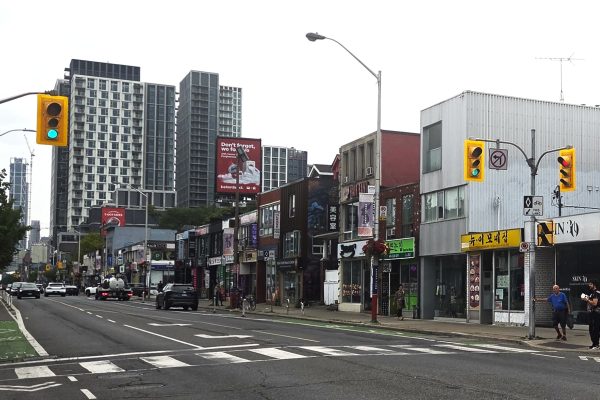
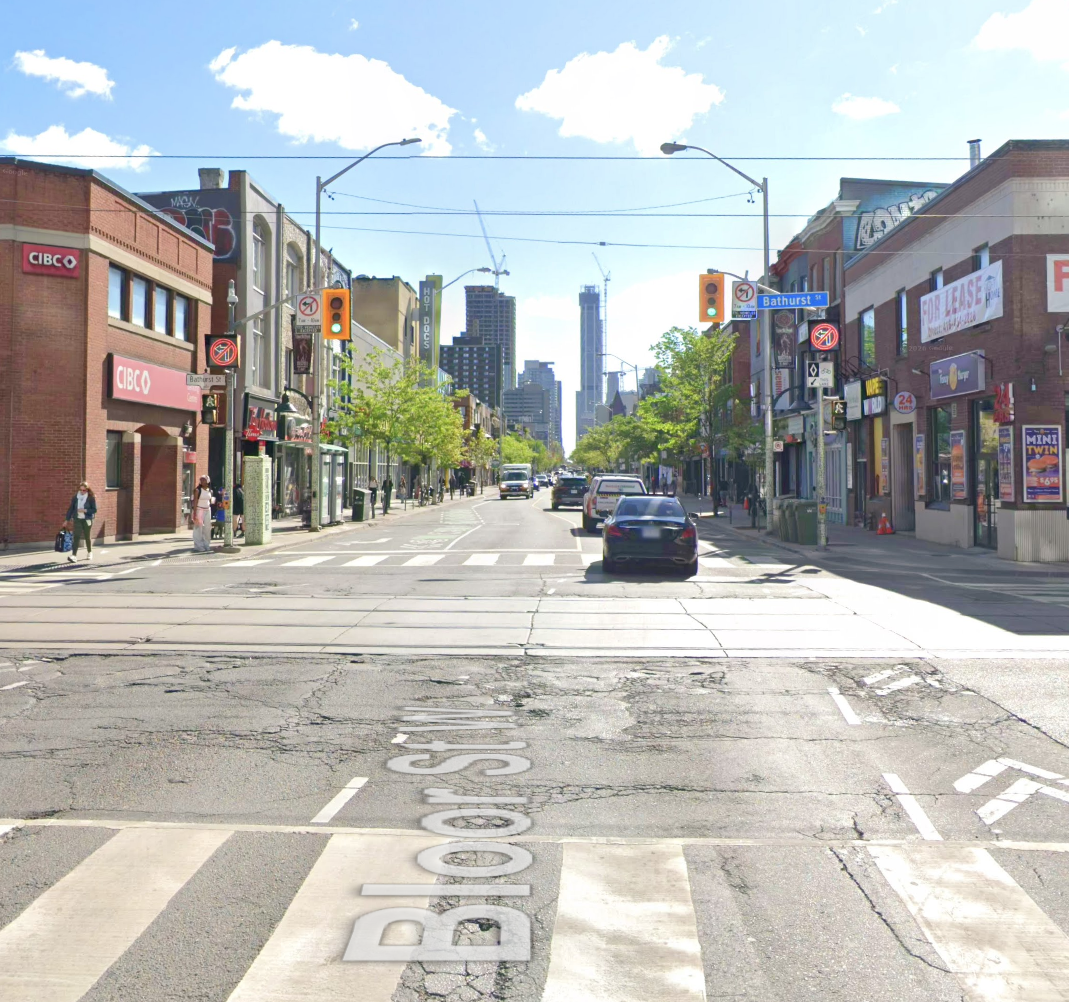
Bloor and Bathurst in Toronto is where the story begins. Looking east down Bloor, the street’s low rooftops gave way in the distance to a cluster of supertall towers, marking Yonge and Bloor, where money concentrates differently than it does along this stretch.
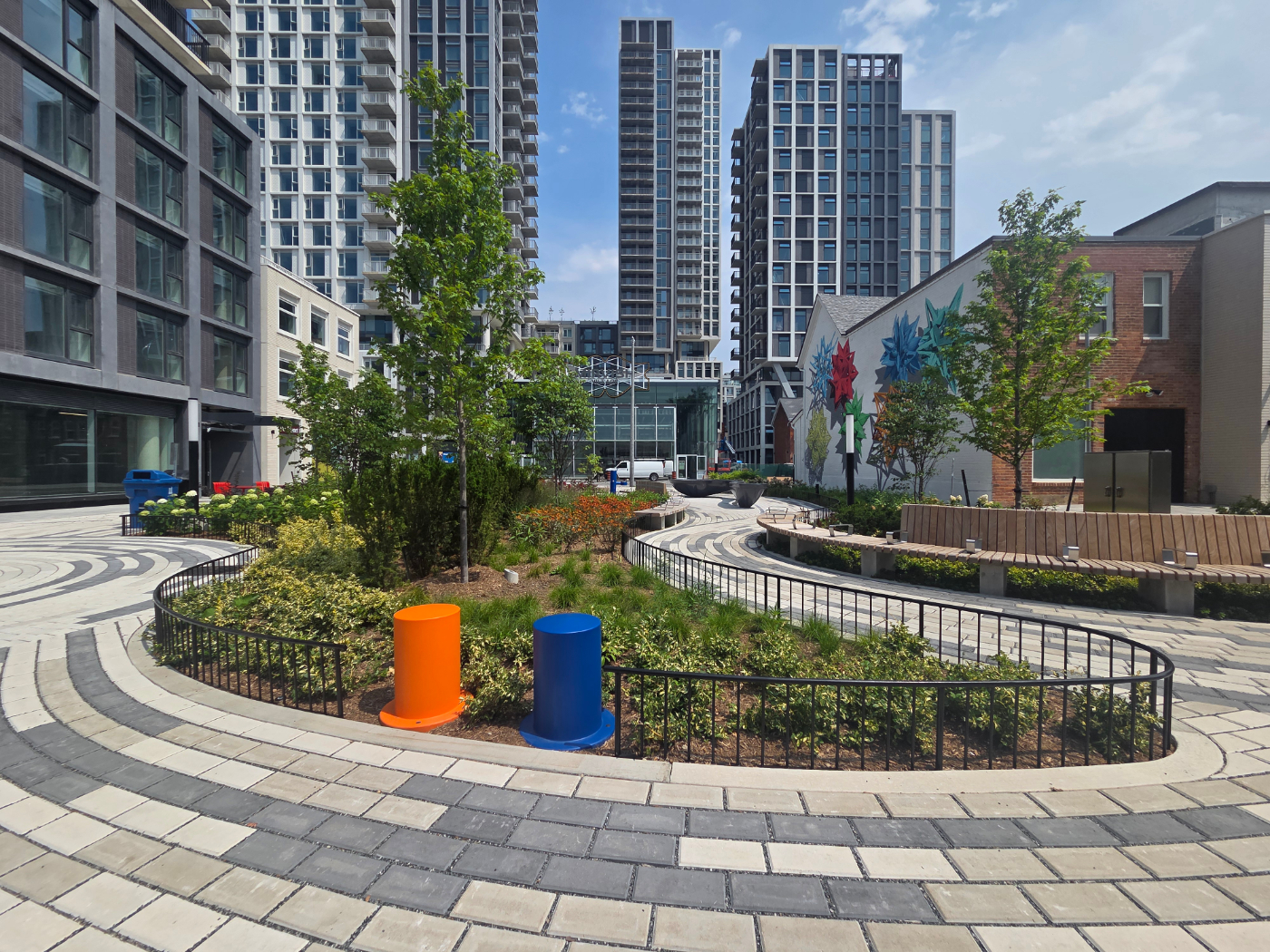
Mirvish
I was sitting on a bench in Mirvish Village on a sunny summer afternoon. Everything around me felt brand new and unused. Looking at it, I asked myself: how will this place look in a generation or two? How will it age? Will it become a gathering place that belongs to the whole city, or will it just cater to the people living in the new towers?
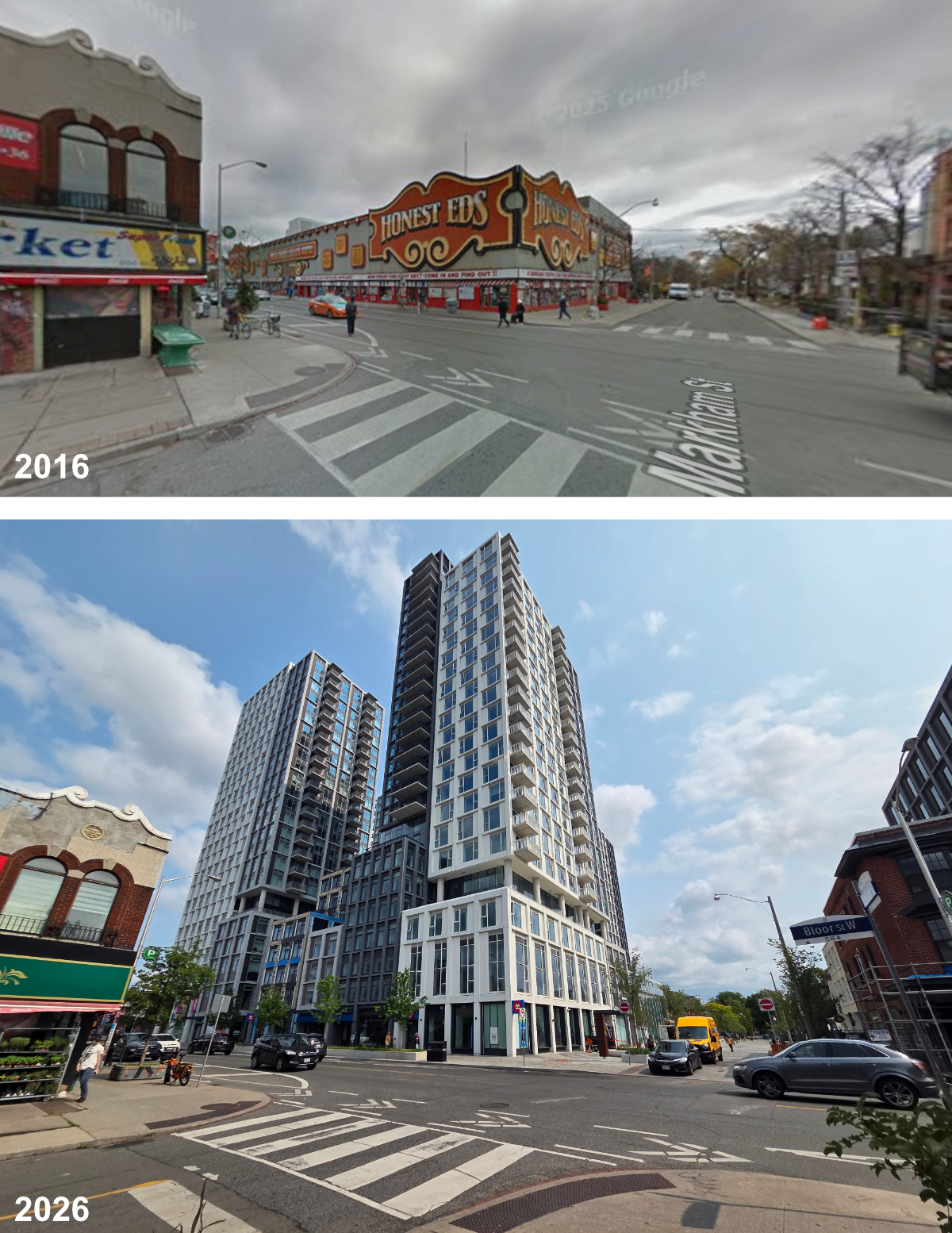
On my first visit to this corner, less than two years after the block closed for construction, I had never set foot in the store that once stood there. Yet everyone around me still remembered it vividly and specifically. It was Honest Ed’s, and even in its absence, it retained a visual identity you could feel secondhand.
A generation from now, that memory will belong to an ever-smaller group. The memory will exclude those who have left us or have let the memory fade away, as well as newcomers and visitors to the city with no prior memory of it. Naturally, the share of people standing on that corner who could actually picture what stood there gets smaller every year.
Seen a decade apart, the corner has changed from a carnival façade to new buildings rising above it, with a generic occupant now in the ground-floor retail below.
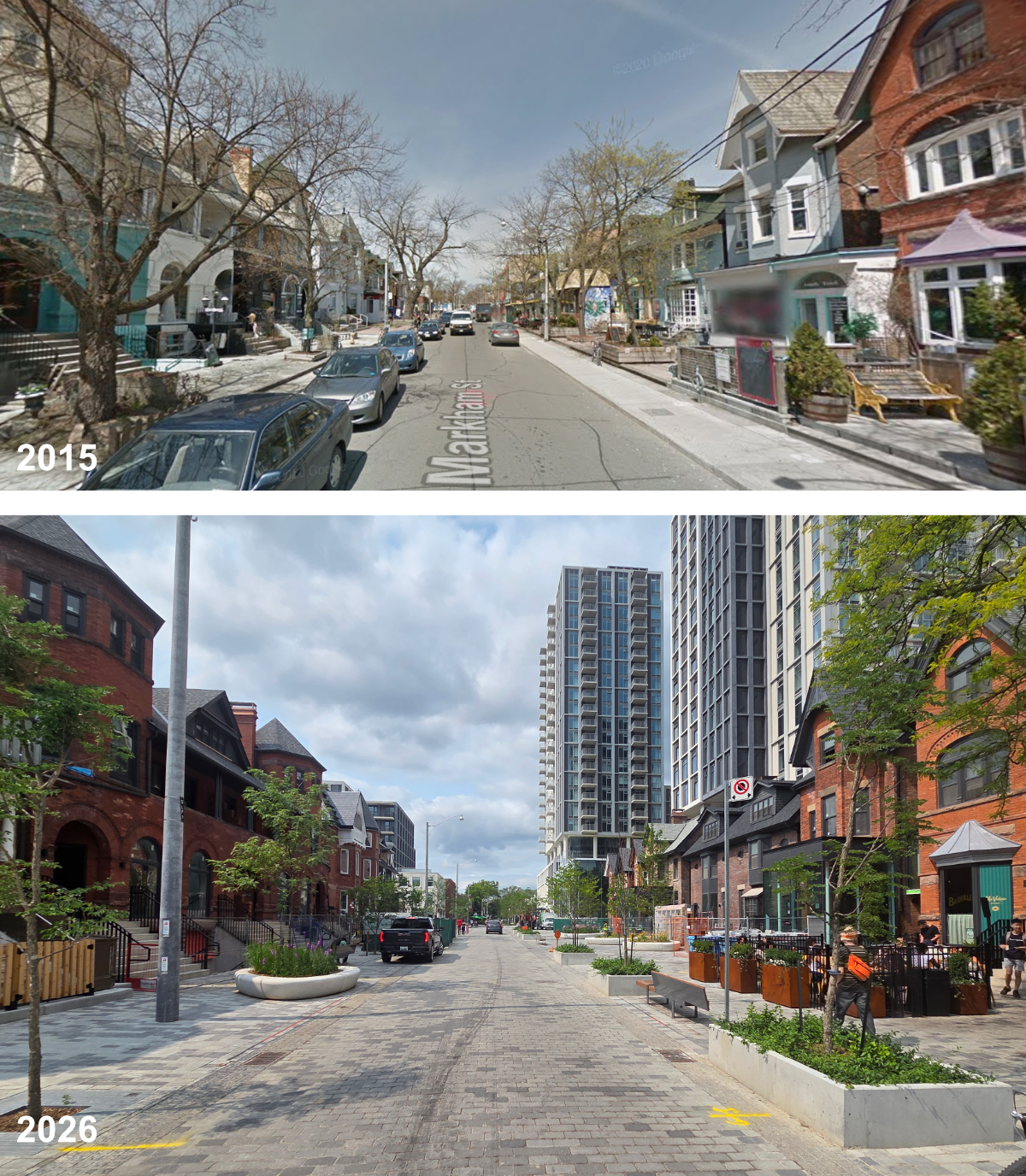
Markham Street was Honest Ed’s original entrance, deliberately placed there since a Bloor Street address meant a higher property tax bracket. Bargain hunters lined up to enter from this side, and the commercial energy spilled onto the short block down to Lennox Street.
Today, the Markham–Lennox corner is the neighbourhood’s side gateway into the new “village,” with a trendy pizza patio at the foot of restored brick buildings.
Previously, Markham was lined with parked cars and mismatched, differently coloured storefronts: a patchwork accumulated over the years. A decade later, on the same stretch, the same brick buildings stand restored, but now in a single, consistent, clean, curated palette. The street itself has become a paved, one-way, curb-less shared space.
Vertical and Horizontal: All at Once and Over Time
Mirvish shows one kind of urban change: a whole block remade at once. Along Bloor, change often takes another form. Businesses change hands, storefronts are altered, and neighbourhood character shifts in increments that can be difficult to date. Jane Jacobs described these contrasting forces as “cataclysmic money” and “gradual money.” On this stretch of Bloor, their difference is visible in the form of the street.
Vertical movement is up and down: people rise by elevator to homes and offices, then descend to the city streets below. Horizontal movement happens at street level, east or west along Bloor, one storefront after another.
Along Bloor
Heading west from Mirvish, I began to recognize shops, cafés, and restaurants that had slipped from recent memory, then returned the moment they came into view.
The strip through Koreatown still feels largely familiar: restaurants, grocers, a supermarket, the soft-tofu restaurant, places that seem permanent. Christie Pits breaks up the two-sided retail strip; further west, the cluster of Ethiopian restaurants and shops feels equally settled. Establishments have surely opened and closed, but not in a way that registers as a wholesale change.
Having just spent a week immersed in research on how fast a street can turn over, I was naturally expecting more change, but more has stayed than I expected. Approaching Dovercourt, I remembered there was a bakery, but couldn’t remember its name, then I looked up and said “Oh, Bloomers.” Just as I had that thought, I glanced ahead, and right in front of me, a brand‑new‑looking, twelve‑storey building. Wait a minute, wasn’t that where the Portuguese bakery was, on the corner?
The earliest available Street View, from 2007, already shows the bakery on that corner. By 2023 the storefront had become a sales office, a miniature architectural model of the building sitting where I once had an espresso and a pastel de nata. By 2024 it was a construction site. Two years on, complete and occupied, “Move in Now,” much quicker than Mirvish.
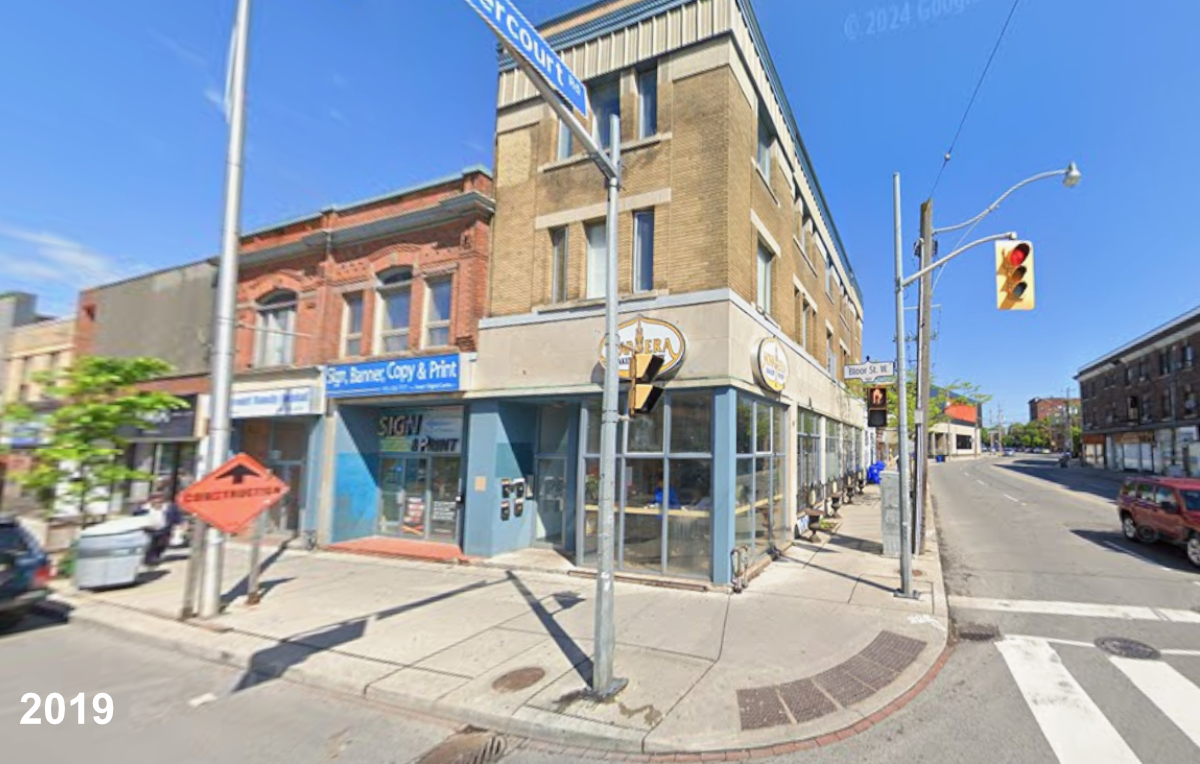
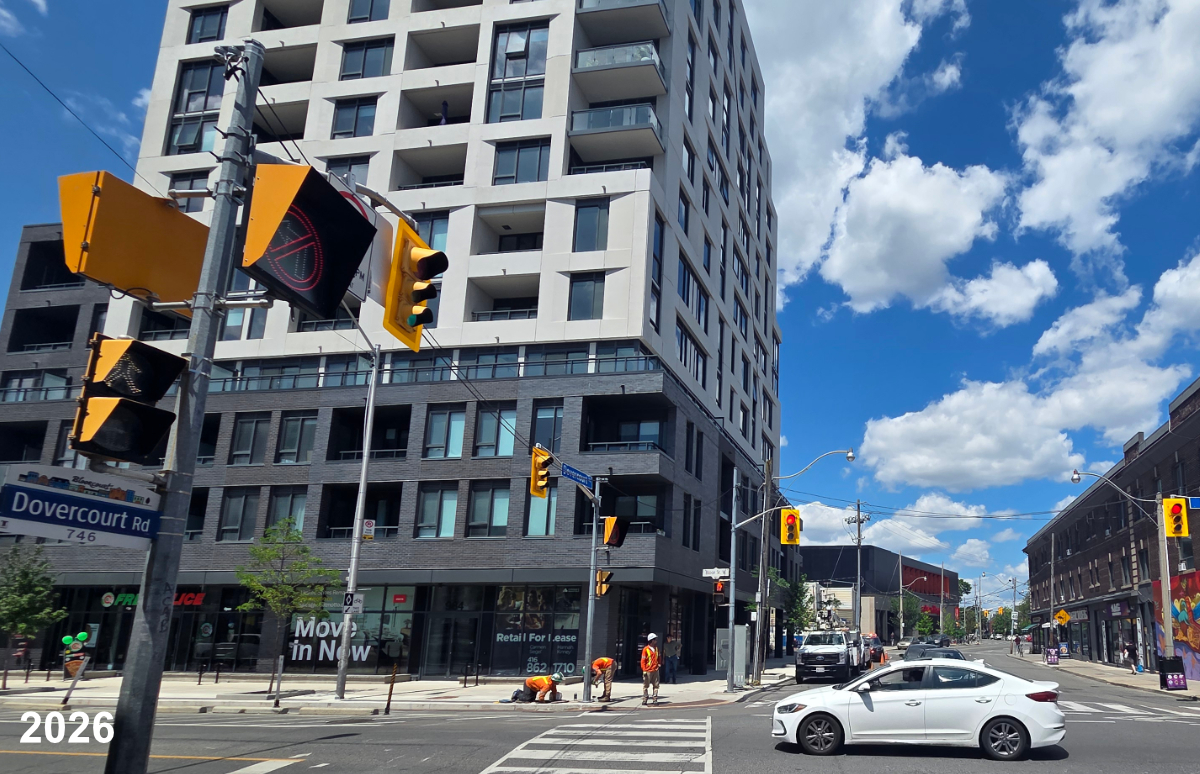
Continuing along Bloor, more of the slow horizontal change pattern until Dufferin.
Dufferin
Dufferin has its own vertical story, its own version of Mirvish. It is another major intersection on Bloor with a subway station, another large mixed-use, multi-tower project built over what had previously been a significant site: in this case, a pair of schools.
The change is most striking from the Bloor and Dufferin corner itself. The new project rises directly over a site that once sat back from the street, becoming a vertical marker on Bloor.
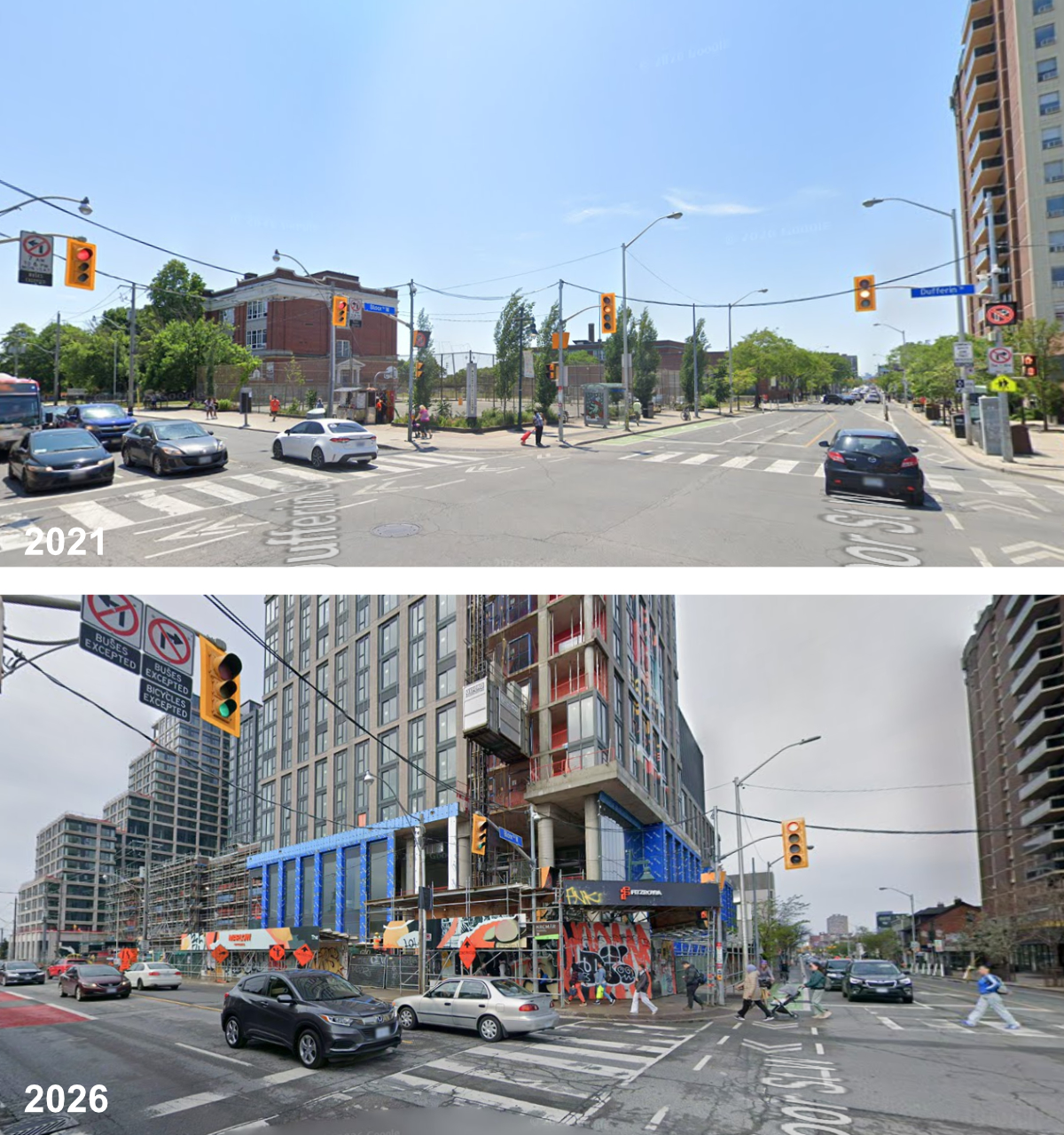
Both projects feature pedestrian-oriented routes through their sites. At Mirvish, there is the curb-less Markham Street and the pedestrian Honest Ed’s Alley, lined with shops; at Dufferin, there is a curb-less private road.
I recall a specific render from when this project was in debate. It showed a curb-less street animated by food trucks and patios, the future as an everyday street festival. Now, passing by the complex while it is still under construction, I wonder whether the completed street will live up to that expectation.
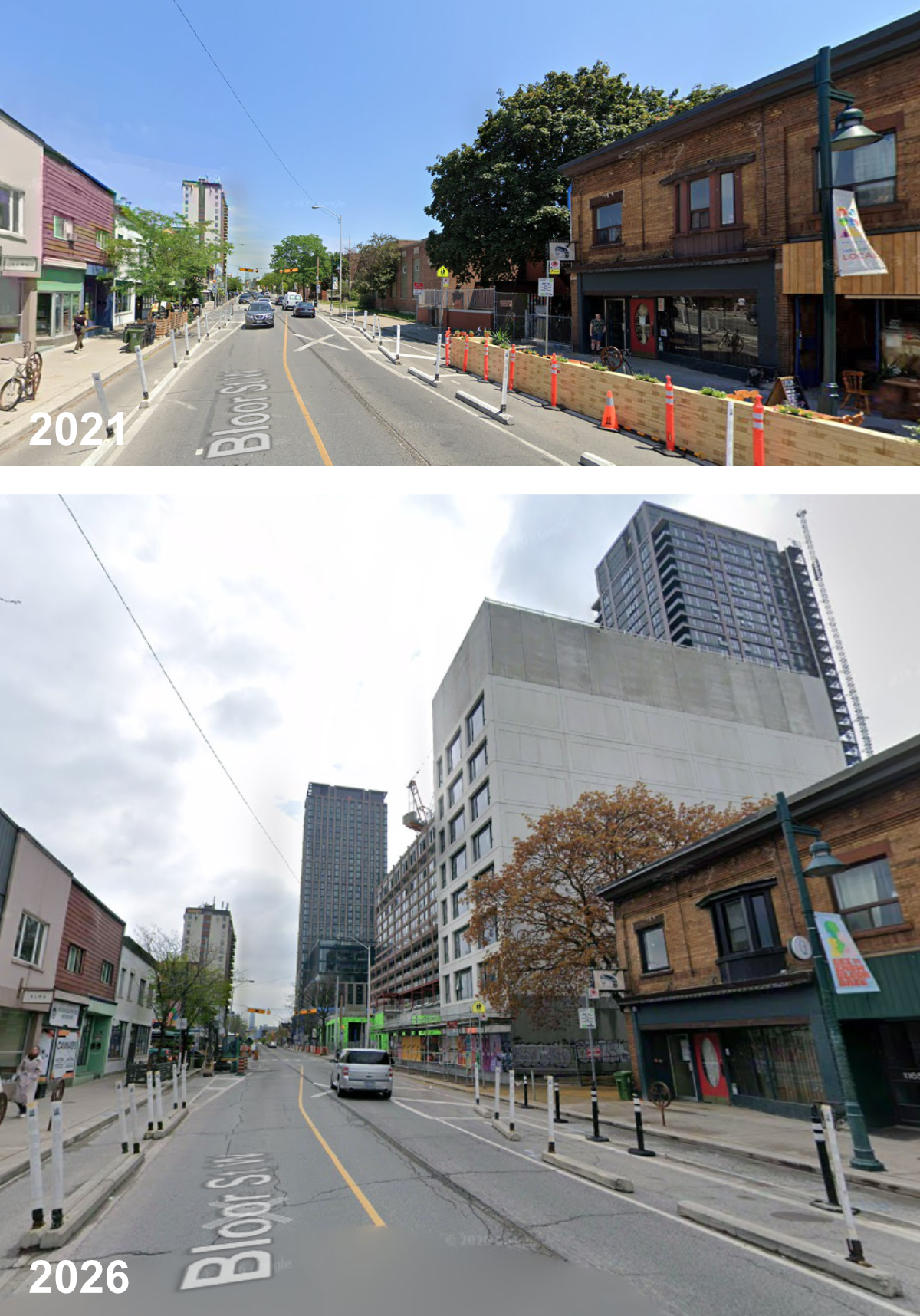
Further west on Bloor, the contrast is more layered. The two-storey storefronts, street trees, and protected bike lanes implemented in 2020 remain in place, but the new development now fills the background. Horizontal Bloor persists at eye level; vertical Dufferin has arrived behind it.
The Bigger Picture
If you drew a cross-section along the whole corridor, this is what it would show: the vertical story above, and underneath it, the horizontal one, the stretch of Bloor between its anchors, from the undeniable cluster around Yonge to the occasional concentrated vertical blip further west, made possible by the likes of Mirvish and Dufferin.
Mirvish and Dufferin are two vertical interruptions along Bloor. They are not simply new buildings, but moments when the long, horizontal experience of the street is suddenly overtaken by a different logic: land assembled, capital concentrated, and a new piece of city built all at once.
Back to Bathurst
Another walk, another day: this time through the corridor’s densest, most urban stretch, heading west toward Bathurst again.
From Sherbourne to Avenue Road, towers form an unbroken row on both sides, cresting hardest at Yonge and Bloor, where I felt the wind funnel through the canyon they create, supertalls close enough to touch on either side.
Past Avenue Road, height holds on the north side while the south drops away, first into the horizontal mass of the ROM, then onto the ground entirely at U of T’s playing fields, where the CN Tower looms in the distance, mostly unobstructed.
Back on the bench in Mirvish Village, the earlier questions return: will this become a gathering place that belongs to the whole city, or will it just cater to the people living in the new towers? How will it age? How will this place look in a generation or two?
Mirvish will likely draw people to its Honest Ed’s Alley, inspired by Tokyo’s alleys, with stacked neon signs, a novelty for the city. A novelty only stays a novelty until it doesn’t. By the same token, Dufferin’s render promised a festive, farmers’-market, food-truck feel on its private street. Will it feel local, or generic?
The wider question is a generation from now, whether interventions like Mirvish and Dufferin change how the whole corridor feels, moves, and who it serves.
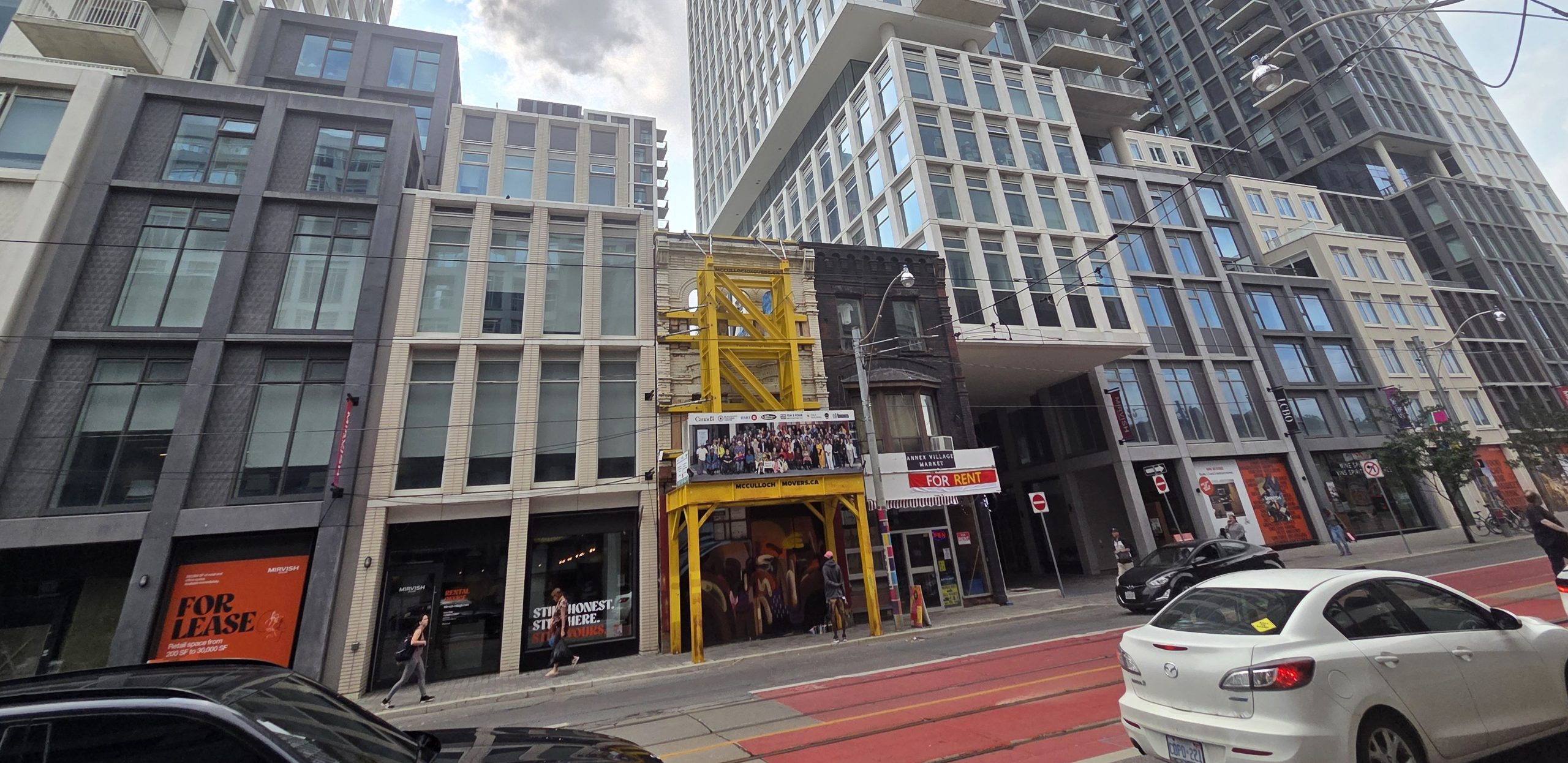
However, there is an outlier to the story: one small building in the massive Mirvish block was spared demolition. Held up now by a yellow steel frame, its old bricks kept, it sits tucked into the base of towers rising on either side, facades staggered at different heights around it, this one relic of the past pinched into the middle of it all. It used to be a shop that sold holistic books, healing crystals, and health food. When I passed it this summer, a convenience store operated there, a “For Rent” sign already posted above it. Shortly after I left, a five-dollar gnocchi window opened in its place. Next time I pass, it may already be something else.
***
Yuval Fogelson is an urban designer, educator, and artist who loves to explore and understand cities. Based in Vancouver, his work spans the built environment, from public space transformations and tactical urbanism to mobility hub networks and digital twins. He is the founder of YF City Urbanism and paints maps as part of Yellow Future City.