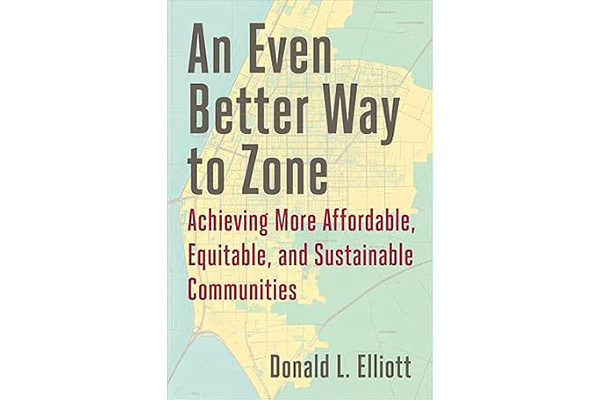

Author: Donald Elliott (Island Press, 2025)
When I first reviewed Donald Elliott’s A Better Way to Zone almost fifteen years ago, I began with a simple observation: cities may appear organic, but beneath their streets, buildings, and neighbourhoods lies an invisible architecture of regulations. Pages of bylaws, maps, definitions, tables, and diagrams quietly determine what may be built, where, and often for whom.
At the time, zoning felt like a remarkably technical subject. Important, certainly, but largely confined to planners, lawyers, and municipal staff. Today, it sits at the centre of debates over housing affordability, climate change, racial equity, economic opportunity, democratic participation, heritage conservation, public health, walkability, and even loneliness.
Increasingly, zoning has become the policy instrument through which we attempt to solve problems that often originate well beyond land-use regulation itself.
Donald Elliott’s latest book arrives at precisely this moment. An Even Better Way to Zone asks a deceptively straightforward question: if zoning has become one of our principal tools for shaping cities, can it also become a better one?
His answer is thoughtful, measured, and refreshingly practical.
Unlike much of today’s housing debate, Elliott refuses to cast zoning as either hero or villain. He acknowledges that modern zoning has contributed to housing unaffordability, social exclusion, and environmentally unsustainable development. He rejects the increasingly common suggestion that zoning itself is the fundamental problem.
Instead, he argues something more subtle: zoning is an extraordinarily powerful legal instrument, but an instrument nonetheless.
Like any tool, its value depends on how it is designed, where it is applied, and what we realistically expect it to accomplish. Problems arise not only when the tool is poorly designed, but when successive generations ask it to perform work it was never intended to do. That simple observation quietly underpins the entire book.
One of Elliott’s most useful contributions is reducing the intimidating complexity of zoning into three simple components: rules, procedures, and maps.
Public debate often fixates on the map. We argue about where density should go, which neighbourhoods should change, or how much housing particular parcels should accommodate. Elliott reminds us that maps are only one-third of the system.
Poorly designed regulations can undermine good maps. Fair rules can be frustrated by cumbersome approval procedures. Generous permissions may still produce little housing if the rest of the system makes development economically or administratively impractical.
It’s an elegant framework because it shifts attention away from ideological battles and toward institutional design.
The book is equally persuasive when discussing redevelopment, and here it is worth pausing on how long Elliott has been circling this idea. In 2008, A Better Way to Zone introduced what he called “mature area standards”—the argument that zoning, drafted with undeveloped land in mind, was then wrongly applied wholesale to neighbourhoods that already existed.
His proposed fix was procedural: benchmark mature areas to their own established character rather than to greenfield standards, and give cities two or three separate sets of development criteria instead of one.
Nearly two decades later, that instinct has become something closer to a worldview. Elliott now argues that zoning is too often written as though cities are blank sheets waiting to receive ideal buildings, when in reality planners spend far more time working with inherited cities: existing buildings, awkward lots, long-standing businesses, mature neighbourhoods, and accumulated investments. Good zoning, he suggests, begins there.
What was once a technical fix for one category of standards has become a governing premise for the whole book. Cities are never finished, and every regulation acts upon landscapes shaped by previous generations whose physical, economic, and social histories continue to matter.
Perhaps the most significant evolution from Elliott’s earlier work, however, is his treatment of exclusion—and here the shift is not one of degree but of kind.
Exclusion barely registers as a concept in the 2008 book at all. That earlier work is organized around fairness, efficiency, and the problem of NIMBYism; it treats zoning’s failures as largely fixable through better governance and clearer rules. In An Even Better Way to Zone, exclusion becomes something closer to a starting premise.
Elliott argues that exclusion is embedded within zoning’s very DNA. Zoning cannot compel someone to build housing, but it can prohibit them from doing so. It cannot force investment, but it can prevent particular forms of development. Every zoning code is therefore an exercise in deciding what, and ultimately who, should be excluded.
It’s an uncomfortable argument precisely because it is difficult to dispute. The question, Elliott suggests, isn’t whether zoning excludes. It always does. The real question is whether today’s exclusions continue to serve the public interest.
Read against the 2008 book, this is less a footnote than a change in register: Elliott has moved from treating zoning’s problems as failures of design to treating exclusion as one of the tool’s inherent properties.
Equally refreshing is Elliott’s refusal to promise easy solutions.
Housing affordability, social equity, and environmental sustainability frequently pull planning decisions in different directions. Increasing housing supply may improve affordability while accelerating displacement. Protecting existing affordable neighbourhoods may preserve communities while limiting redevelopment. Higher environmental standards may produce better buildings while making them more expensive to construct.
This, too, has a history in Elliott’s thinking. Back in 2008, he wrote about “predictable flexibility”—his observation that citizens and developers alike want predictability when it favours them and flexibility when it doesn’t. And that good governance means being honest about which is which rather than pretending a system can offer both at once, everywhere, to everyone.
That same instinct animates his treatment of trade-offs here: rather than pretending competing goals can be eliminated, Elliott asks planners to confront them honestly. That willingness to acknowledge trade-offs, rather than hide them behind slogans or silver bullets, is increasingly rare.
The book also raises a broader question. Have we begun treating regulatory problems and structural problems as though they were the same thing?
Because zoning is the institution through which so many urban conflicts become visible, it increasingly bears responsibility for solving them, regardless of where they originate.
If housing is unaffordable, we reform zoning. If neighbourhoods remain segregated, we reform zoning. If emissions remain high, we reform zoning. If local economies struggle, we reform zoning.
None of these responses is unreasonable. But together they suggest something larger: zoning has become the arena through which society increasingly tries to resolve problems whose origins often lie elsewhere.
Throughout the book, Elliott reminds readers that markets respond to regulations. Developers build where projects remain financially viable. Investment follows opportunity.
All true.
But markets do not merely respond to zoning. They anticipate it, speculate upon it, capitalize future entitlements into land values, and shape the very regulations that later appear as neutral technical decisions.
Zoning isn’t simply reacting to markets. It also helps construct them.
That distinction matters more than the book has room to cover, because it bears directly on one of the defining planning questions of our time: the widening gap between entitlement and outcome.
Across North America, and particularly in Canada over the past several years, governments have expanded development rights dramatically. Height limits have increased. Parking requirements have fallen. Missing-middle housing has been legalized. Approval processes have been streamlined. Blanket rezonings have become increasingly common.
Many of these reforms have produced enormous theoretical housing capacity while yielding far fewer completed homes than anticipated.
Elliott acknowledges this reality but generally treats it as evidence that zoning alone cannot guarantee development. That is certainly correct. But it also points toward a question just beyond the book’s scope.
If markets don’t just respond to zoning but help construct it, then the entitlement gap isn’t simply proof of zoning’s limits; it’s evidence that the thing being entitled—land value, speculative capacity, future permission—was never only a zoning question to begin with.
Answering it requires looking past zoning toward land ownership, financial systems, development economics, public investment, taxation, and political power.
This is less a criticism of Elliott than an observation about where his own best insight, followed further, would lead.
Nearly fifteen years after reading A Better Way to Zone, I remain impressed by Elliott’s ability to make one of planning’s driest subjects intellectually engaging.
But the main pleasure of this sequel is watching an idea mature. The technical fix of “mature area standards” has become a governing premise about inherited cities. The tactical honesty of “predictable flexibility” has become a broader refusal to promise painless trade-offs. And a vocabulary that once had no real place for exclusion now treats it as zoning’s defining property.
That arc—reformist instincts hardening into something closer to a structural account of what zoning actually does—is the real story of this book, more than any single argument within it.
An Even Better Way to Zone will reward planners and land-use lawyers most directly, but it deserves a wider readership: anyone arguing about zoning reform, from either side, would be better for reading Elliott’s patient case that improving zoning and improving cities are not necessarily the same task.
It doesn’t resolve today’s debates over housing, equity, sustainability, and governance. Instead, it reminds us that one of planning’s hardest tasks is distinguishing between problems that regulation can solve and problems that regulation merely exposes.
***
For more information on An Even Better Way to Zone: Acheiving More Affordable, Equitable and Sustainable Communities, visit the Princeton University Press/Island Press website.
**
Erick Villagomez is the Editor-in-Chief at Spacing Vancouver and teaches at UBC’s School of Community and Regional Planning. He is also the author of The Laws of Settlements: 54 Laws Underlying Settlements Across Scale and Culture.