
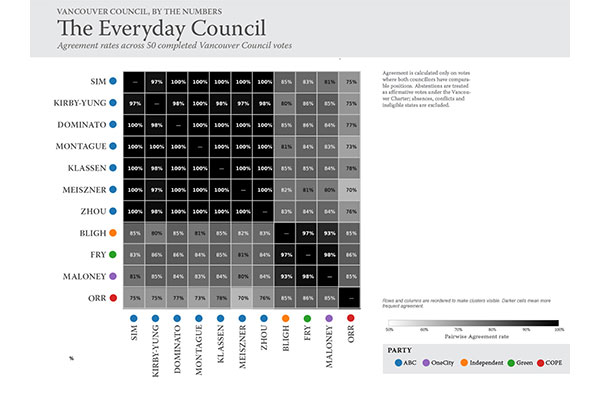

Last April, shortly after Vancouver’s by-election, I turned the result into a game. It was admittedly a geeky one. Going into the by-election, ABC controlled seven of Vancouver City Council’s eleven seats and had demonstrated remarkable voting discipline. Two vacant seats couldn’t change that majority. But they could change the political dynamics around it. So I posed a question: If voters wanted to challenge an overwhelmingly dominant governing bloc, which combination of candidates would be most effective?
I called it the Retroactive By-Election Game.
It wasn’t a simulation so much as a thought experiment. Using previous voting records and political affiliations as proxies, I ranked the possible outcomes by how closely the candidates might align with ABC. Two TEAM councillors offered outright opposition. Green and OneCity looked more likely to reinforce the existing consensus. Then there was the combination voters actually chose: OneCity and COPE.
At the time, I described that pairing as “cautious alignment paired with volatility.” OneCity seemed likely to vote with ABC relatively frequently. COPE appeared considerably less predictable. The exercise ended with a question that couldn’t yet be answered: What does effective opposition look like inside a supermajority?
We now have some evidence. And the first thing it suggests is that I was asking the wrong question.
Since the by-election, I’ve tracked 50 completed Council votes. Of those, 23 are particularly useful for analysis: decisions involving housing, planning, development and governance where differences among councillors are most revealing.
For every pair of councillors, I calculated how often they voted together on comparable votes. Absences, conflicts and instances in which councillors were ineligible to vote were excluded, meaning different pairs can have slightly different sets of comparable votes. Under the Vancouver Charter, councillors who abstain are deemed to have voted in the affirmative (Section 145.1 (3)), so abstentions were counted as votes in favour. Where I refer to “agreement with ABC,” I mean agreement with the ABC majority position on each comparable vote.
The Council that emerges doesn’t divide neatly into government and opposition.
ABC is a bloc
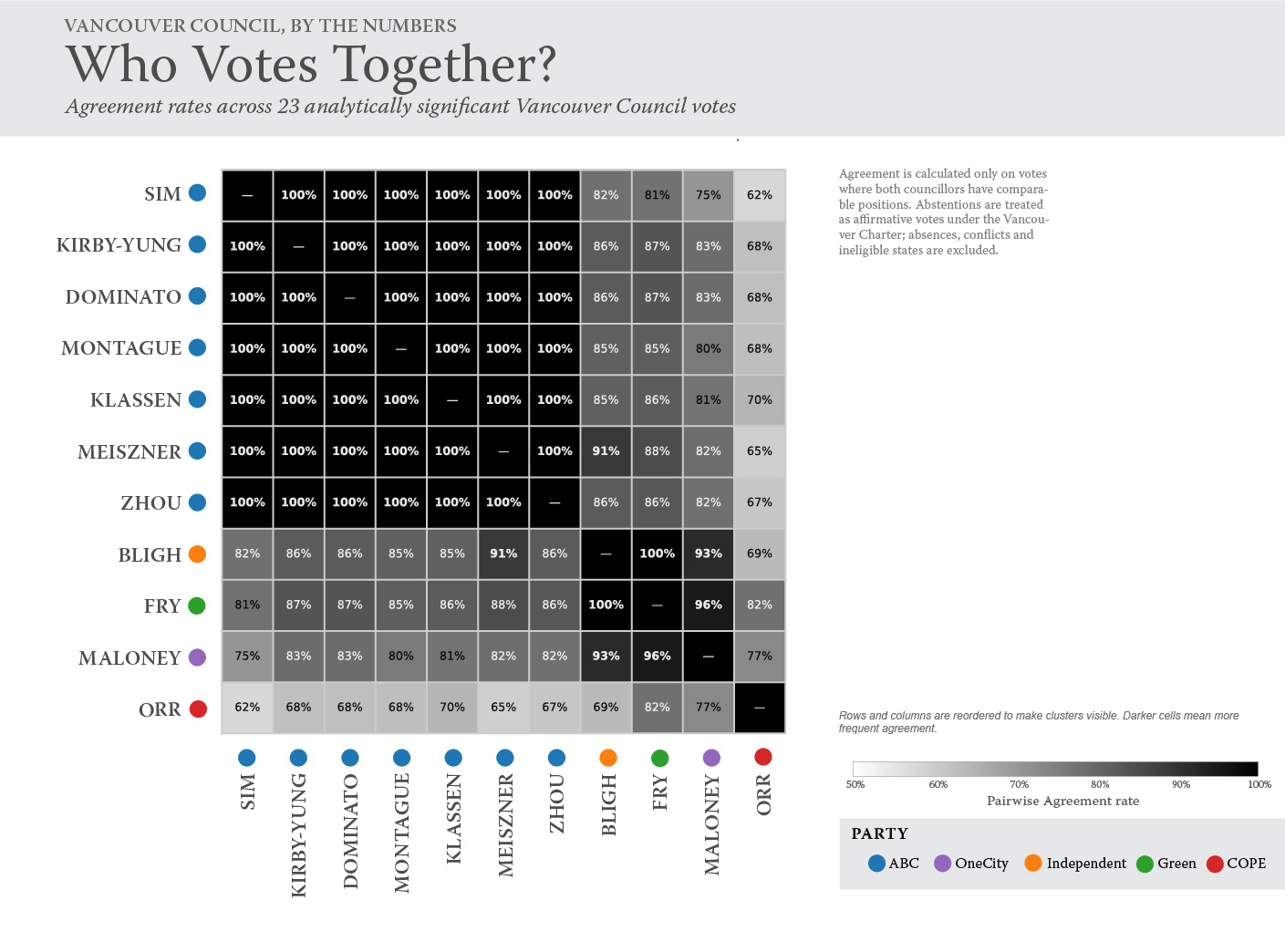
This was the easiest prediction. Across all 50 votes, the average agreement rate among pairs of ABC councillors is approximately 99 percent. Narrow the analysis to the 23 significant votes and ABC councillors agree 100 percent of the time.
Voting records can’t tell us why councillors agree. They reveal outcomes, not motivations. But as an observable voting coalition, ABC is extraordinarily cohesive.
Outside ABC, something very different is happening.
There is no opposition bloc
The original game treated the two successful by-election candidates, OneCity’s Lucy Maloney and COPE’s Sean Orr, as a political combination. They haven’t become one. Instead, some of the strongest relationships outside ABC cut across party labels.
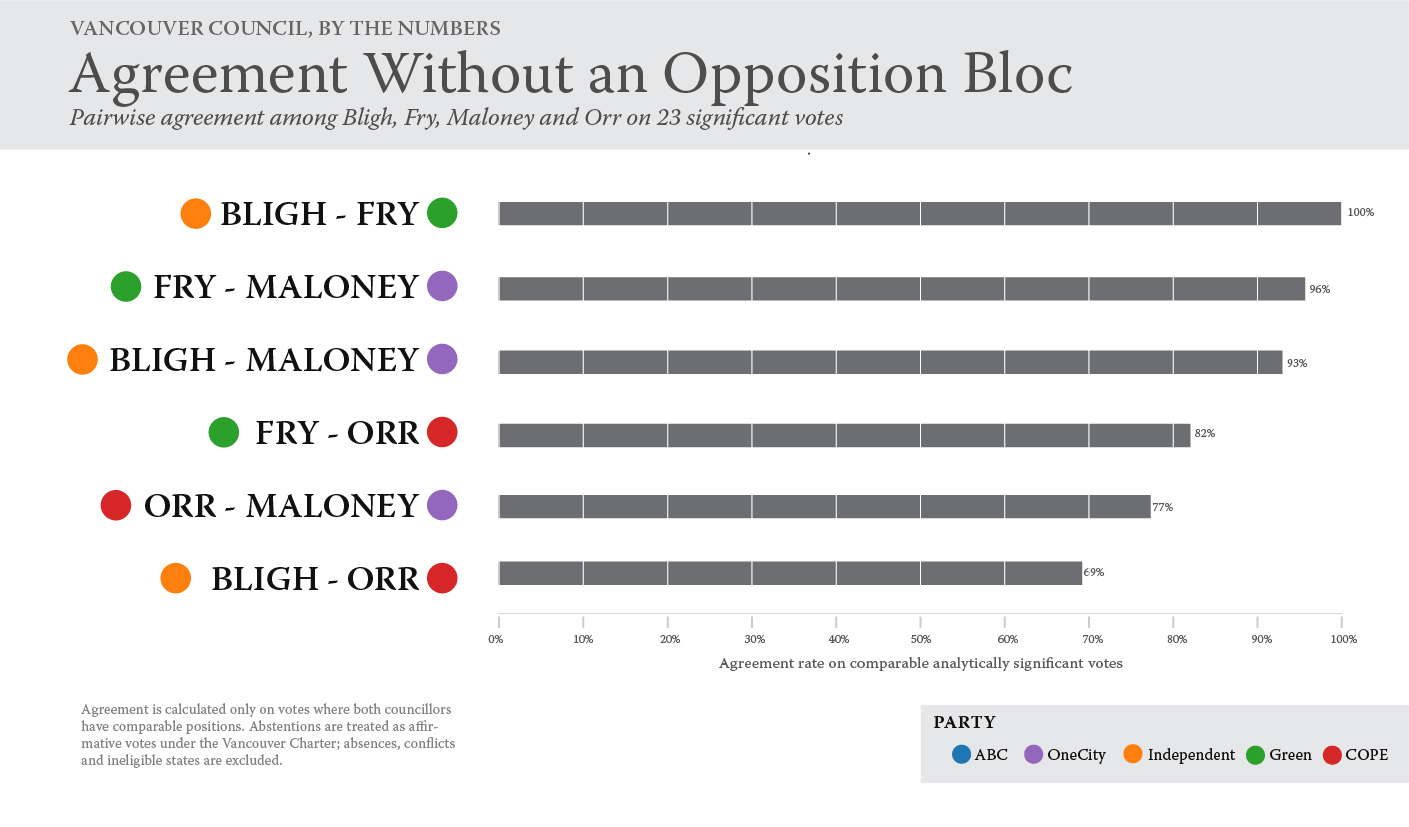
Among the 23 significant votes, Rebecca Bligh and Pete Fry agree on every comparable vote. Fry and Maloney agree 96 percent of the time. Bligh and Maloney agree 93 percent. Orr is more distinct, but not disconnected: he agrees with Fry 82 percent of the time, with Maloney 77 percent and with Bligh 69 percent.
At first glance, Bligh, Fry and Maloney might therefore look like a bloc of their own. But there is a crucial difference: they rarely vote against ABC.
Across the same significant votes, Fry agrees with the ABC majority on 87 percent of comparable votes, Bligh on 86 percent and Maloney on 83 percent. Even Orr, Council’s most distinct voter, agrees with ABC 68 percent of the time.
That makes “opposition bloc” a difficult description. Bligh, Fry and Maloney vote together remarkably often, but most of the time they are also voting with ABC. Orr departs from ABC more frequently, but not often enough to turn the four councillors into a coherent counter-bloc.
The by-election produced two new councillors, not a new voting bloc.
Housing makes the picture even stranger
Housing is a useful test because it’s among Council’s most consequential and contested policy areas. Nine of the significant votes fall specifically into housing policy, social housing or housing economics.
Fry agrees with the ABC position on eight of nine comparable housing votes, or 89 percent. Bligh agrees on six of seven, or 86 percent. Maloney agrees on seven of nine, or 78 percent. Orr agrees on five of eight, or 63 percent.
Among the four non-ABC councillors, Bligh and Fry agree on every comparable housing vote. Fry and Maloney agree 89 percent of the time; Bligh and Maloney, 86 percent; Fry and Orr, 75 percent.
Nine votes aren’t enough to define anyone’s position on housing, and agreement doesn’t mean councillors arrived at their votes for the same reasons. But the expected partisan fault line doesn’t appear here either. If anything, Fry’s housing votes place him slightly more often with ABC than his already high overall alignment.
Focusing on the most publicly controversial decisions since the by-election related to housing—the Official Development Plan, the Jericho Lands, Rupert and Renfrew Station Area Plan, and the Villages Plan—there is 100 percent agreement across all councillors, except for Lucy Maloney: the only councillor who voted in favour of the Villages Plan.
Even on housing, Council doesn’t resolve into ABC on one side and an opposition on the other.
From game board to network
This is where my original game went wrong. I arranged candidates along something resembling a line, from most likely to align with ABC to most likely to oppose it. Effective opposition became a question of where candidates fell along that line.
Actual voting behaviour doesn’t arrange itself so neatly. Party labels still matter. They tell voters something about political organization, electoral coalitions and the ideas candidates associate themselves with.
But labels flatten behaviour, too.
An Independent, a Green and a OneCity councillor can vote together more than nine times out of ten while each also votes with the ABC majority more than eight times out of ten. Two councillors elected in the same by-election under different opposition banners can be less closely aligned with one another than either is with councillors elected years earlier. Council’s most distinct voter can still vote with the governing majority more often than against it.
The voting record doesn’t invalidate political labels. It reveals what they leave out.
There are limits here. Fifty votes remain a small sample of Council’s work, and deciding which 23 are analytically significant involves judgment. Recorded votes tell us little about negotiations, amendments or why councillors ultimately arrived at the same position. Agreement isn’t ideology.
Still, some of the original predictions held up. ABC remains remarkably cohesive. Orr has emerged as Council’s most distinct voter. And the two councillors elected in the by-election never became a pair.
The line itself didn’t survive.
Last April, I asked what effective opposition might look like inside an ABC supermajority. The voting record raises a more foundational question: is there an opposition bloc to begin with?
Based on the data, the answer is no.
There’s a governing bloc, extraordinarily disciplined. Outside it are councillors who frequently agree with one another but, on most significant votes, agree with ABC as well. They separate issue by issue and vote by vote, occasionally breaking from the governing majority, but rarely cohering against it.
That’s not an opposition bloc. It’s a shifting network operating in the shadow of one.
***
Addendum: What Happens When You Count Everything?
There was one obvious limitation to the analysis above: selection.
I originally tracked 50 completed Council votes and identified 23 that seemed particularly useful for understanding political alignment. That let me focus on decisions where differences among councillors were most revealing. But it also introduced judgment into the analysis.
In response to questions from readers, I analyzed a much larger City dataset containing 693 recorded Council votes since the by-election, trying something very simple: count everything.
Across the complete record, Rebecca Bligh and Pete Fry each agree with the ABC majority on approximately 83 percent of comparable votes. Lucy Maloney agrees about 81 percent of the time and Sean Orr about 79 percent.
The relationships among the non-ABC councillors are even stronger. Bligh and Fry agree on approximately 97 percent of comparable votes. Bligh and Maloney agree 96 percent of the time. Fry and Orr agree 95 percent. Even the least-aligned pairing, Orr and Maloney, agrees roughly 94 percent of the time.
These percentages shouldn’t be compared too literally with the smaller analysis above. The complete dataset includes the routine, broadly supported decisions that make up much of Council’s work, while the original analysis deliberately focused on votes where political differences were more revealing.
But that’s precisely why the larger dataset is useful. Remove the judgment involved in selecting significant votes and the basic picture survives.
ABC remains an extraordinarily cohesive governing coalition. Outside ABC, councillors frequently vote together, but they also frequently vote with ABC. Orr remains the most distinct of the four. And there still isn’t a stable opposition bloc sitting opposite the governing majority.
If anything, 693 votes make the central point of the original analysis harder to dismiss as an artifact of selection.
The line still doesn’t survive.
**
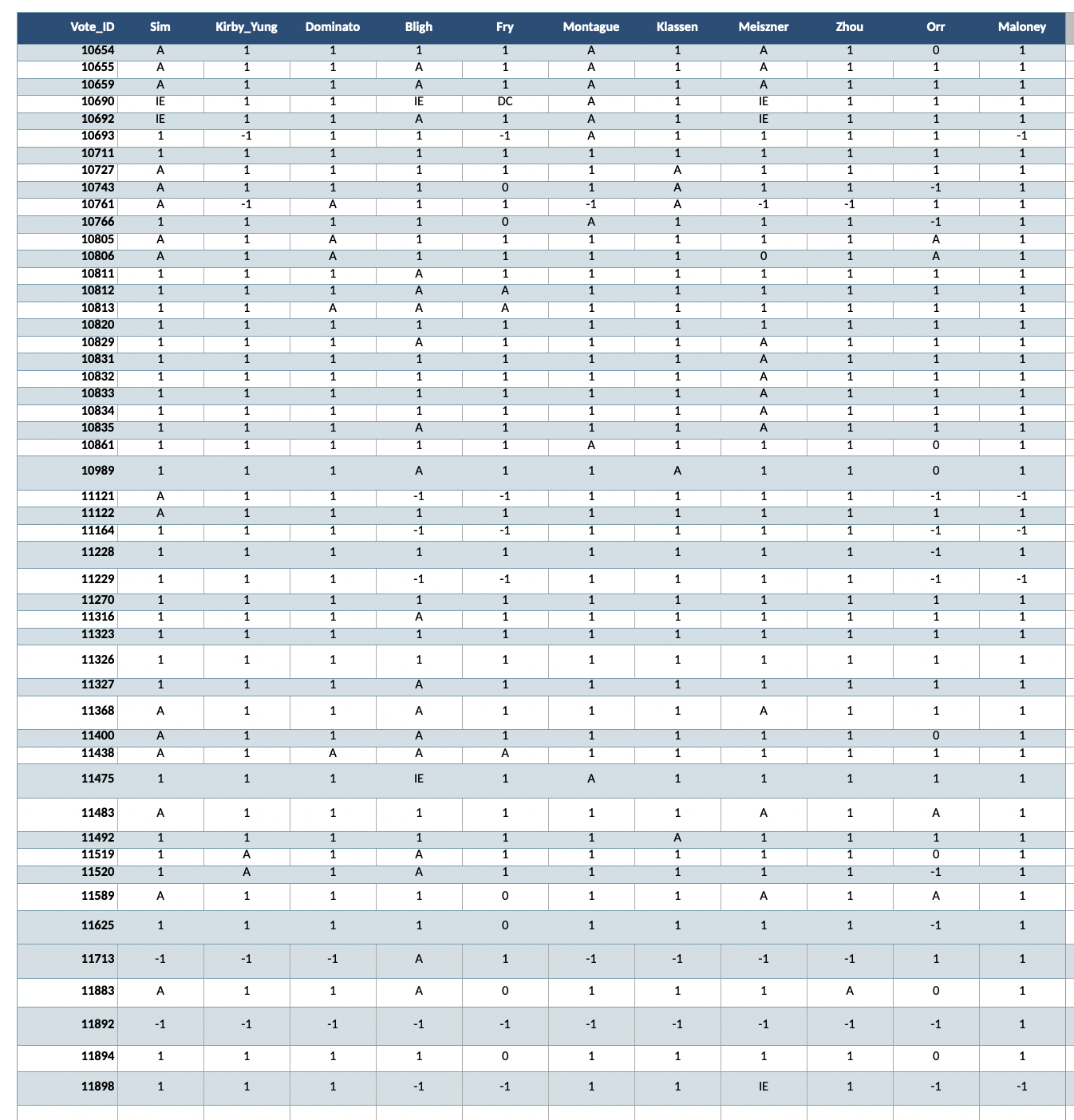
Here is a simplified version of the 50-vote spreadsheet used for the analysis.
**
Related Spacing Vancouver pieces:
*
Erick Villagomez is the Editor-in-Chief at Spacing Vancouver and teaches at UBC’s School of Community and Regional Planning. He is also the author of The Laws of Settlements: 54 Laws Underlying Settlements Across Scale and Culture.
One comment
In my limited experience, ABC will never actually vote against a motion they oppose, instead amending and neutering the motion. Final vote then is still unanimous as no one wants to vote nay for “creating safer after school pickups” even if it is now just a ‘direct staff to look into this” vote. I would love to see this analysis on just amendments as I think this is where the opposition occurs.