Parks
March 15th, 2010
As the West Don Lands neighbourhood continues to take shape, Waterfront Toronto is being forced to reconcile with the unique challenges of the area. One such challenge has been how the area will interact with the elevated overpass that carries Richmond, Adelaide and Eastern Ave through its heart. To the north of the overpass will be a Toronto Community Housing (TCHC) project and the River City condo development, while the heart of the new neighbourhood, including the athlete’s village for the Pan-Am games and the expansive new Don River Park will be built to the south. Thus, ensuring that the overpass does not become a barrier will be an important element of the neighbourhood’s success.
Mitigating the negative affects of the overpass will not be easy as there are significant psychological misgivings about such dark spaces with low ceilings. Underpass Park aims to address both the problems and importance of the site, and plans are very promising. Construction on the 2.5 acre site will begin in May and will cost $5.3 million with completion slated from Spring of next year.
September 23rd, 2009
Spacing Magazine, the City of Toronto, and Ward 20 City Councillor Adam Vaughan have teamed up to give Torontonians a chance to name a new park. This new green …
Categories Parks
August 13th, 2009
Playter Gardens sits at the northeastern end of the Prince Edward Viaduct, a stamp-sized park bordering Cambridge Avenue and Danforth. Overgrown and untended, crack-pipes are often found littered around the park. Only one flower garden still remains to back up Playter’s namesake. Instead, high grasses and dead branches lie in the dense shadow of dangerously leaning trees.
Although abandoned by most of the neighbourhood, not all has been lost. Transplanted would better describe the evolution occurring at northwestern edge of Danforth Ave. As Playter Gardens has declined over the last two years, small gardens have been popping up along Cambridge Ave., plots that have been rapidly expanding. A variety of plants, vegetables and even trees are now growing in the formerly unused grass beds that line the street.
I caught up with Chris, a Cambridge Ave. resident and the driving force behind these guerrilla plantings, who explained that his inspiration for these gardens wasn’t just aesthetics. After being fed up with cars continually running over the grass across the street from his house as they cut the turn into their apartment garage a little too close, Chris decided to take matters into his own hands and created what would be the first of many Cambridge Gardens.
July 24th, 2009
Biking along the Eglinton bridge over the Humber, I spotted a tiny little garden on the eastern bank of the river just north of the bridge. The garden is almost entirely concealed and can only be spotted from several spots along the northern sidewalk of the bridge just west of Scarlett. The outline of the garden and its irrigation mounds can just barely be made out on Google Maps.
Upon closer inspection, it turned out to be startlingly well-kept and well-tended, growing a variety of plants protected by an elaborately built fence built out of branches and wire. There was even a small locked gate facing the river, with a thin dirt path leading to large flat stones ideally placed along the bank of the Humber for collecting water.
I spent a bit of time trying to research this garden and found that it was featured in a Jane’s Walk, but that the gardener is an “anonymous newcomer.” The property is technically owned by the Toronto and Region Conservation Authority, but my bet is that the garden is either entirely off their radar or they are simply turning their heads to allow the gardener(s) to work.
March 26th, 2009
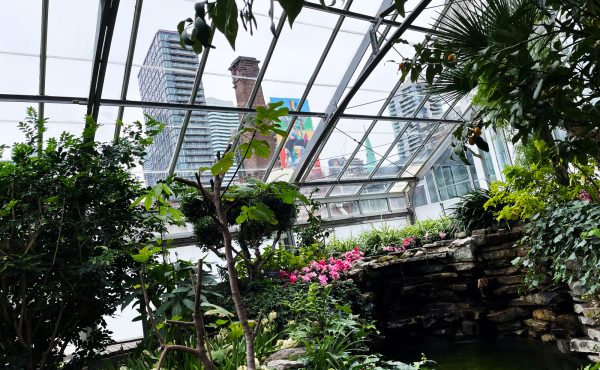
Having grown up in the “city of lakes“, I find Toronto’s waterfront to be a welcoming refuge from the dry air and cement that characterizes the rest of the city. Of particular interest is The Toronto Music Garden, located on the south side of Queen’s Quay West, in between Lower Spadina Ave and Dan Leckie Way. During the summer it is a haven for butterflies and other insects, and is surprisingly quiet given its juxtaposition between the island airport and the Gardiner Expressway.
March 24th, 2009
At the Toronto Pedestrian Committee meeting yesterday, we learned about the new version of the Toronto Parks and Trails map, which has just been released. The latest version is new and improved after consultations with members of the public who …
February 18th, 2009
EDITOR’S NOTE: Spacing contributing editor Christopher DeWolf is now based in Hong Kong and will make occasional posts about his unique public space experiences abroad. Chris was also the driving force …
February 11th, 2009
The Guild Inn, 2008, by Olena Sullivan.
EDITOR’S NOTE: This is Heritage Toronto’s Gary Miedema final post in his series on at-risk heritage structures around the city included in their upcoming “Building Storeys†exhibit at the Gladstone Hotel that runs February 17-22.
- - - - - - - - - - -
If you grew up in Scarborough, you likely know what the “Guild Inn†is. Until it was closed in 2001, it seems like 3 degrees of separation connected everyone to the place, located roughly where Eglinton Avenue runs into Lake Ontario in Scarborough. Like the Inn on the Park in Don Mills, it was a magnet for wedding receptions, anniversaries, and photo shoots.
And for good reason. The Guild Inn was a place of romance and loaded with charm. A rambling collection of additions upon additions, the core of the Inn itself was the country estate house of Colonel Harold C. Bickford. Born in what is now Trinity Bellwoods Park in a demolished house called ‘Gore Vale‘ (Bickford’s family name was given to another park along the Garrison Creek between College Harbord and Bloor), Harold became a military man, fought in the in South Africa during the Boer War, rose to the position of Brigadier-General in World War I, and then led western anti-Bolshevik forces in Russia. He built his house in Scarborough in 1914, with stables for his horses and a garage for his cars. It was a perfect spot on the edge of the Scarborough Bluffs, on beautifully forested land. From his windows and lawns, Bickford and his large family enjoyed stunning views over Lake Ontario.
The former Bickford house prior to expansion as the Guild Inn. Photo courtesy of Guildwood Village Residents Association
For a few years at least. Bickford sold the home in 1921, and the building first became a house for Roman Catholic missionaries destined for China, then the home of a wealthy businessman. Then, after sitting empty for a few years, the rambling estate was purchased by the daughter of a leading Ontario family and the heiress of a Brantford shoemaking company, Rosa Breithaupt Hewetson.
The year was 1932 – the darkest year of the Great Depression. Meeting Spencer Clark, a young man who shared her vision, Rosa got married again and began “The Guild of All Arts†in earnest.
Rosa and Spencer Clark in the 1930s. Photo courtesy of Guildwood Village Residents Association
At the heart of the Guild of all Arts was the Clarks’ commitment to the arts and crafts as elements necessary for the fullest enjoyment of life. Influenced by Roycroft in New York, Rosa and Spencer invited artists and craftspeople to the Guild of All Arts, where they were provided room and board in return for sharing their work and skills with the Guild and its visitors. Some of the original 40 acres of the guild lands were converted to fields in order to produce food on site and as cheaply as possible. Goods produced at the Guild — everything from weaving to leatherwork and sculpture — were sold in its gift shop. Further income would be gained from visitors who would come to take courses from the skilled artists and craftspersons on site, and to enjoy the beautiful surroundings on top of the bluffs.
January 29th, 2009
The gh3 design firm, based here in Toronto, has been chosen as the winner of the international design competition for June Callwood Park. Spacing’s Shawn Micallef originally wrote about this competition back in …
Categories Parks
January 26th, 2009
Milne House (2008), photographed by Olena Sullivan
ED: Heritage Toronto’s Gary Miedema will be making a series of posts on structures around the city included in their upcoming “Building Storeys” exhibit at the Gladstone Hotel that runs February 17-22.
What do you do with an abandoned historic farmhouse that’s listed on the City’s Inventory of Heritage Properties, and now nearly strangled by bush in a Don Valley conservation area?
Next time you are stuck in northbound traffic on the Don Valley Parkway between Eglinton and Lawrence, you’ll be in a great place to ponder that question. After the railway underpass just past Eglinton, you’ll descend down into the bottom of the valley, which quickly widens out. Not far away, on top of the valley wall on the left, are 1950s Don Mills homes with backyard swimming pools. Invisible on the crest of the valley to the right are the sprawling industrial buildings of Railside Road. Down in the valley, where the highway is only a few feet above and beside the river, you are cruising through the ghosts of Milneford Mills.
Detail from the 1878 Illustrated Historical Atlas of York County showing Milneford Mills (circled) in its larger context. Yonge Street, punctuated by the communities of Eglinton and York Mills, runs up the left side of the map.
Detail from the 1878 Illustrated Historical Atlas of York County with today’s Lawrence Avenue detouring to cross the Don River at Milneford (centre of map). Black dots represent buildings. “S.M” represents the Milnes’ saw mill, “W. Mill” their woolen mill.
Details from the 1878 Illustrated Historical Atlas of York County showing a (no doubt embellished) Milneford, the 1878 Woolen Mill, and a Milne residence
In its heyday in the mid-to-late nineteenth century, Milneford Mills was a cluster of some 16 buildings. (An embellished lithograph made in 1878, shown above, portrays an idyllic valley scene). What is now Lawrence Avenue detoured down along the east valley wall, curved through the settlement, crossed the river, and made its way up the other bank to rejoin the straight concession line. Evidence from the census returns and period maps indicate that in addition to two water-powered mills, one a rare woollen mill, Milneford Mills boasted a dry goods store, a wagon shop, and workers’ housing. The homes and barns of the Milne family, proprietors of the whole business, joined them. Their fields stretched out of the valley, but an aerial photograph from 1939 still shows fields in the valley itself. According to an 1851 census, the Milnes grew wheat, peas, oats, potatoes, turnip, hay and apples. In around the homes and barns were “bulls or oxen, milch cows, horses, sheep and pigsâ€. Wool, fulled cloth, butter and pork completed the farm produce.