Transit
February 9th, 2010
Intersections are inherently a competition for space and time. In many places in the world, intersections are still governed largely by the assertiveness of the participants. Crossing the street in many parts of Italy drivers will not stop unless you walk out onto the street. In orderly Toronto, the nature of intersections has been heavily institutionalized and regulated; we expressly decide which parties will have the priority at intersections in the city based on the importance we place on different modes of transportation.
While it is easy to argue that our society gives this priority to cars, Toronto is taking steps, albeit small ones, to shift its priorities and institutionalize intersections where transit and pedestrians are the primary focus.
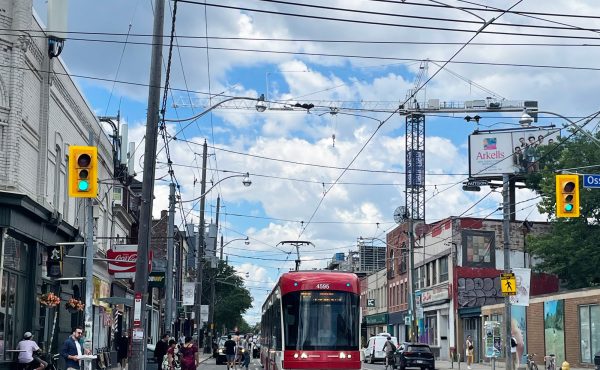
Toronto began gradually implementing signal priority for streetcars along Queen Street in the mid 1980s and since then has expanded the program to 332 intersections across the city. You will likely experienced — possibly unknowingly — a handful of signal priority intersections if you travel on the Queen, King, College, St Clair, Dundas, Gerrard, Bathurst, and Spadina streetcars or Dufferin, Jane and Finch West buses. The city has the goal of implementing priority along one route every year and is currently working on Finch East. Bruce Zvaniga, at Transportation Services filled Spacing in on some of the details of how the signals work for transit vehicles.
As a streetcar (or equipped bus) approaches an intersection it is picked up as part of the control system’s loop. Upon detecting the transit vehicle, the system will hold its right of way for two second intervals, until the vehicle has passed. This can last a maximum of 30 seconds. If the vehicle is facing a red light the system can initiate the pedestrian countdown and shorten the opposing green up to 15 seconds.
February 7th, 2010
Below is a repost of my Eye Weekly Psychogeography column that appeared last week. The TTC has, obviously, had a bad few weeks (worse than the US Democratic Party’s January, maybe). That’s no fun for them, but it’s good for the rest of us because it’s a perfect storm of complaint, anger, citizen reporting and an election year that has led to movement on issues that have been systemically ignored for years. Earlier in the week The Star’s “Fixer” was incredulous at Chair Adam Giambrone’s acknowledgment that customer service is a problem after earlier denials and just yesterday TTC general manager Gary Webster released a letter to employees regarding this heretofore elephant in the TTC’s boardroom.
It’s easy to be cynical and wonder “why now” — those of us who have been riding the TTC for a long time have all experienced routine events like drivers leaving a running bus or streetcar to get coffee, and certainly management did too. So, how to manage this perfect storm now that it’s blowing change all over the city? Can it be channeled into someplace not-angry and useful, with long term effect (that is, beyond this election cycle)? Perhaps, as I write below, a TTC Riders Union could fill that void. Responses to this column and the past week’s events-at-large have reinforced my call for an ideologically-free union (with no ties to either side of the political spectrum). On the right we’ve heard the usual tired calls to “crush the union” while the left shifts any blame from workers to either management or chronic funding problems (a problem, yes, but not an excuse for bad customer service and broken corporate culture). Both look at the TTC through ideological goggles and, as I write, a TTC Riders Union can’t do that in order to be successful.
Last year in this space I wrote about quitting my near-decade-long TTC metropass subscription. It was a difficult decision, but the routine anger and frustration I felt using the system was tarnishing my experience of Toronto. As expected, the rider rage is largely gone, because now I can abandon the streetcar stop anytime, as I haven’t prepaid for bad service. Now I walk directly to places two to four kilometres away, without any wait-and-see delay. This also is the first year I’ve continued to ride my bike into January (the warmish, desert-dry winter we’ve been having is, admittedly, helping). Once you start winter riding, it’s easy and it can be all done without looking like a fleece and GORE-TEX Mountain Equipment Co-op gear fetishist.
As I mentioned in that column, my living and doing most things roughly within the old city of Toronto boundaries makes this possible, a luxury a lot of Torontonians don’t have, so my escape from the TTC is not an option for many customers. One letter to the editor in response to that column suggested I was being irresponsible by abandoning the TTC, that I should have stayed and worked to make it better from the inside, as if there is some kind of altruism in submitting yourself to the bad machine for the greater good.
There is hope on the horizon though, and it isn’t Adam Giambrone’s “Blue Ribbon Panel” of experts looking at how the TTC can improve its customer relations. That’s a good thing, certainly, but we all have a hard crust of cynicism when it comes to change happening from inside at the TTC, a bureaucracy that some city hall insiders refer to as (with appropriate apologies to the disabled) the “most autistic of the city’s agencies.” TTC management has a habit of blaming riders for problems (whether subway delays or the removal of the “Walk Left — Stand Right” signs) and now, so does its union.
February 5th, 2010
This post is part of a series of articles exploring the Environmental Assessment process and how it’s shaping Toronto. The series focuses on four major developments currently at the EA stage.
Though you may not know much about the person sitting next to you on the streetcar, chances are you have at least one thing in common: you both want to get to where you’re going quickly. Whether we are heading towards Kennedy Station or a revitalized approach to urban transportation, we’re understandably impatient about arriving at our destination.
In the case of a better transit system, each of us is silently groaning, “are we there yet?” And why shouldn’t we? Changes to the TTC will alter our paths and patterns, economic possibilities, and environmental realities in a way that few other projects can.
Like a long ride with many transfers, the environmental assessment process is notoriously arduous — which is why the Ontario Government made the bold move in 2008 to streamline transit undertakings as a unique class of environmental assessments known as Transit Project Assessments.
In this edition of the EA series, I’ll be looking at the Transit Project Assessment process through the lens of the Scarborough-Malvern Light Rail Transit (SMLRT) project. This project, in various incarnations, has been a transit pipe dream since the 1980s. Bandied back and forth for several decades, it gained steam with the Transit City announcement in 2007 and again last year when Toronto’s 2015 Pan Am Games bid was accepted.
February 4th, 2010
Standing on the platform of Hong Kong’s Tsim Sha Tsui station at 11:30 on a Tuesday night, watching crowd after crowd filter into already busy subway trains, you come to understand the importance of the MTR to the city pretty quick. On top of being one of the world’s most densely populated cities, Hong Kong’s geography (a crowded island separated by a busy harbour from a mountainous territory) poses unique problems to transportation planners. Mix this with a political climate that some claim to be amongst the most neoliberal in the world (the Hong Kong government moved heavily in the 90’s to divest itself of public utilities), and you have a very unique and fascinating transit system that is a hot bed for innovation.
The backbone of the system is clearly the MTR subway and rail system. The first line of which opened in 1979 and has since expanded to cover over 211km with 150 stations; although some of this expansion was accomplished through a takeover of the existing Kowloon Canton Railway (KCRC).
The subway is marked by several features, most notably its utilitarian design. Similar to Toronto, many stations are colour coded for easy recognition. Public art is not particularly common and food and drink is banned from the fare paid area. Glass barriers separate the platform from the track at all stations, and give the platform itself a much more comfortable and enclosed feel. The most noticeable characteristic of the system however is the ever-present crowds. This hits home the fourth and fifth time you hear the trilingual announcement reminding people to stand clear of the doors.
February 1st, 2010
Say this for Adam Giambrone’s long-shot run for mayor (which he launches tonight at Revival): As TTC chair, his very presence in the race all but guarantees that we will have a roiling, gloves-off debate about the future of transit in Toronto.
Coming off last week’s mea culpa and the launch of the external customer service review, Giambrone says his top priority for the TTC is completing all of Transit City. Rocco Rossi, by contrast, has pledged to put the multi-billion dollar project “on hold,” pending a financial review. George Smitherman wants to press ahead, but blames the city’s “leadership” for the $40 million cost over-run on the St. Clair right-of-way.
During council last week, Spacing asked all city councillors (except chair Sandra Bussin) to identify their top priority for improving the TTC.
Here are the replies, grouped by theme:
CUSTOMER SERVICE:
Brian Ashton: Paradigm shift to customer service culture.
Bill Saundercook: Expect every operator to be an ambassador for the ridership.
Paula Fletcher: Enhance customer service by permitting riders to buy tokens with credit and debit cards, and allowing convenience stores to sell Metropasses.
Peter Milczyn: Change the culture so everything the TTC does is viewed through a customer service lens.
Joe Mihevc: Institute a service culture from top to bottom.
Anthony Perruzza: Re-focus the TTC’s business delivery model from a transit system into a service provider.
Gloria Lindsay Luby: Improve driver safety while providing more customer service training for operators.
January 27th, 2010
Adam Giambrone took some time this afternoon to address the fast escalating criticism of customer service on the TTC. His message was one of commitment to a new focus at the commission. Acknowledging the ‘perfect storm’ of bad press that started with the botched fare hike and culminated last week with a slew of pictures of sleeping employees; the Chair stated that this is was an opportunity the commission could seize upon to refocus itself on the issue of customer service.
“Focus” was indeed the word of day, with little new to announce in terms of initiatives, other than a new customer charter, Giambrone stated that the TTC would accelerate items already in the capital budget and work to put customer service forefront in the minds of its employees. Included in the list of quick fixes was the online trip planner, which Giambrone said would be released in beta some time next week and would be complemented by the release of necessary data to Google Transit (a mobile version of the trip planner is to come out this summer). Also included is a program to put SMS numbers on all streetcar stops that will allow for instant next car information to be sent to your phone; Giambrone is confident this service will be implemented by July. This service was promised for bus stops by 2011.
January 27th, 2010
As Transit City pushes forward — the Finch LRT was approved yesterday at city council — with the goal of providing reliable public transport to the forgotten reaches of the inner suburbs, it will be a challenge to ensure that areas of existing coverage aren’t forgotten in the process. The residents of the southwestern communities of Mimico, New Toronto and Long Branch have become a vocal and organized group, claiming they have already been forgotten. Far from just complaining however, residents in the area have a plan for action, and they’re pitching it aggressively.
The Lakeshore Planning Council is a citizen’s group dedicated to reviewing and advocating planning issues in South Etobicoke. Of late, the group has turned its attention to what has become a foremost issue in the community: service, or lack thereof, on the 501 streetcar. The planning council notes that service along Transit City bus routes such as Wellesley, receive much more frequent service despite lower ridership. The communities along the western waterfront were some of Toronto’s original ’streetcar suburbs’ and as such, have streetcar service built into their very existence for both local trips and commutes into the city.
Problems started in 1995 when the TTC retired the old 507 route that used to serve between Long Branch and the Humber Loop in favour of a single extension of the 501. Since then, residents in the area have watched service slip badly.
January 25th, 2010
“Keep it clean,” says the advisory at the top of Trash Talk the TTC. “Harassment or discrimination is not tolerated.” Well, good. That’s an important policy to have. But we shall see how long a public message board called “Trash Talk the TTC” actually remains a locus of civil discussion.
Because, despite the name, civil discussion does seem to be the intent. Launched Sunday by John Loerchner, an art director at ad agency MacLaren McCann and coordinator of Labspace Studio in Leslieville, TTTTTC is marked by an unexpected earnestness. The introductory letter to Adam Giambrone on behalf of “Riders of the TTC” is stern but affectionate, irked yet hopeful. It promises the site will yield “honest and constructive feedback.”
January 25th, 2010
For the TTC, it’s been a perfect storm. In under a month, we’ve seen the fare hike, Richard Soberman’s post mortem, Rocco Rossi’s call for a Transit City moratorium, The Napping Photo, and yesterday’s terrible accident involving a driver whose car was t-boned as it tried to make an illegal left across the St. Clair right-of-way.
To regular riders, of course, The Photo is merely a variation on the theme – in league with the guys on the phone, the guys obsessively re-counting the coin, the guys yakking with off-duty colleagues, etc.
More remarkable was Amalgamated Transit Union president Bob Kinnear’s admission, in Saturday’s Globe and Mail, that three-quarters of the collectors are “down there for medical reasons.” Since when did fare collection become the TTC’s de facto worker’s comp strategy? One would think that someone in Kinnear’s position would know enough to keep that nugget under lock and key.
TTC chair Adam Giambrone has ordered up a customer service review, led by outside private sector advisors. But isn’t this a case of slamming the barn door after the horse has bolted? It would have been much better if he’d made that move after he took over as chair in 2006, rather than waiting until the eve of the mayoral race. And he was certainly aware of the issues.
When I spoke to George Smitherman yesterday, he said such “horror stories” are “a symptom of a bigger problem,” which, in his view, is the need for tougher oversight and “executive leadership.” “The mayor must answer to the people of Toronto for the TTC’s performance.”
January 24th, 2010
A little late-night sleuthing by Spacing editors has landed us the domain name of the TTC’s new web-based trip planner. As we revealed earlier this week, the TTC is set to launch the trip planner in the coming week.
We suspect that tripplanner.ttc.ca will be the launching pad for the application. From the looks of the site, it’s pretty obvious that the interface is not complete since there is no TTC logo or matching template from the TTC’s current web site (see images below).
I’ve used the planner tonight for about 30 minutes and had mostly good success: if I entered specific addresses the results came back quickly; if I entered an intersection as a starting point the application would take upwards of 10 seconds to return a result.
I entered a few trips that are lengthy and that I travel on occasion (such as from south Parkdale to the northeastern edge of North York); the planner turned-up reliable results on which routes to take (they were almost always the same routes I’d take). The planner also provided accurate estimates of the time the trip would take.
I have a handful of screen-captures of the three phases of the planner just in case the TTC decides to block anyone from accessing it until it’s complete. It seems to incorporate Google Maps in the final phase when you click on “view details of this trip”.