Waterfront
March 2nd, 2010
Spacing Radio 017 is on the air.
It’s budget-time in Toronto and while City Hall is busy at work approving the final numbers, host David Michael Lamb sits down with Spacing …
January 5th, 2010
This is the first of a four-part series of articles exploring the Environmental Assessment process and how it’s shaping Toronto. The series will focus on four major developments currently at the EA stage.
Of the people, for the people, by the people.
Sure, Lincoln may have been referring to American governance in his Gettysburg Address, but his words stand for Ontario’s Environment Assessment Act too. Indeed, the Province inscribed our primary environmental planning tool with Lincoln’s sentiment: “The purpose of this Act is the betterment of the people of the whole or any part of Ontario by providing for the protection, conservation, and wise management in Ontario of the environment.”
But how well does our Environmental Assessment Act work? Does this safeguard ensure that our environment is protected? Does it facilitate the betterment of the people of Ontario? How would we know if it did?
Over the course of this four-part series, I’ll be assessing the Environment Assessment (EA) process. Using the lens of four major projects currently winding their way through the bowels of the EA system, I hope to share some perspective on the nature of the process and its success in protecting our environment. First up: the Gardiner Expressway and Lake Shore Boulevard Reconfiguration Project.
Initiated in 2008 by the City of Toronto and Waterfront Toronto, a corporation set up by federal, provincial, and municipal authorities to oversee revitalization of the waterfront, the Gardiner Reconfiguration will determine the future of two major arteries and reinvent our relationship with the waterfront. Because of the scale and nature of the project, it been termed an “Individual Environment Assessment.” With an eye to the potential for large environmental impacts, the Ministry of the Environment requires that a Terms of Reference (ToR) document be produced to guide the EA process. Think of the ToR as a map to guide us from an infrastructure idea to a (hopefully) revitalized reality.
December 3rd, 2009
Cross-posted from Spacing Ottawa, by Michael Frojmovic
For those not familiar with local fare in Trinidad & Tobago, a mix of dried channa (chickpea), roasted peanuts and splitpeas is certainly one of the world’s great beer snacks. Accompanied by a cold Carib beer and a demi-caraffe of water served up in the air-conditioned lounge of the Hyatt Regency Hotel, they help nurse a tired pedestrian through the 15 minutes it takes to recover from an 30-minute evening walk through Port of Spain. Walking in Trinidad after sunset is not a common practice. If you travel on foot from New Town, through Woodbrook, to the Hyatt, you’ll face long stretches of empty streets, punctuated by the odd vagrant, without even a single honk from taxi drivers. Even as the sun sets, the humidity remains oppressive.
My own destination was Port of Spain’s newest waterfront development; specifically, the publicly accessible waterfront promenade. A waterfront city, Port of Spain was designed – much as numerous Canadian and American cities – with its back turned to the water. From a pedestrian’s point of view, the waterfront was separated by walled-in port facilities, and a major 6-lane arterial roadway (Wrightson Road) which functions as a highway.
December 3rd, 2009
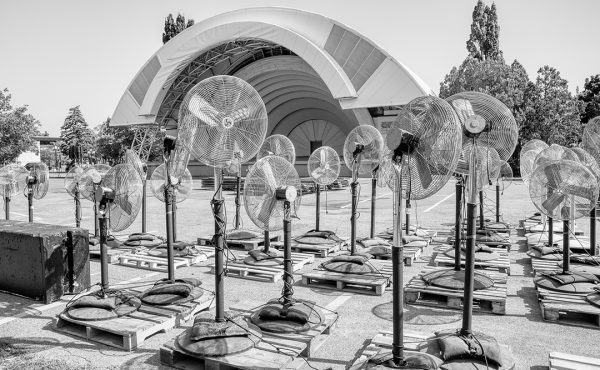
The waterfront in black and white.
Street Scene will appear each week showcasing the illustrations of local artist Jerry Waese.
December 1st, 2009
A “milestone day in the effort to revitalise Toronto’s waterfront”, according to John Campbell, President and CEO of Waterfront Toronto, as the design for the Parkside development was unveiled. Although the item was held in Council earlier in the day and an initial press conference with the architect and Mayor Miller was cancelled, the design is expected to be approved by the end of the current session.
The mixed-use development, designed by internationally-renowned architect, Moshe Safdie, with developer Great Gulf Group, will be a premier residential and commercial building of approximately 36-storeys, rising from a 38-metre high podium base. It will also be the first private sector development in the East Bayfront neighbourhood . Sitting at the bottom of Lower Sherbourne Street, facing Sherbourne park, the tower will extend from Queens Quay, to the South, to Lake Shore Boulevard, to the North. The new building will join the future Corus Entertainment headquarters and the new George Brown College’s Centre for Health Sciences in the first stages of this large scale redevelopment plan.
October 13th, 2009
Like I am in the Riviera.
Street Scene will appear each week showcasing the illustrations of local artist Jerry Waese.
August 31st, 2009
Here’s something for public space advocates to chew on: With their plan for a $38 million tunnel …
August 9th, 2009
Yesterday afternoon, the Rees wavedeck was opened to the public officially launched. The third of four wavedecks to open following the Spadina and Simcoe wavedecks, only the …
June 18th, 2009
As the debate heats up over what the future of the Gardiner holds, local architect Les Klein proposes a radical new plan. Vannessa Lu’s article in the Star looks at Klein’s new design …
June 18th, 2009
Every Thursday, Spacing will bring you a snapshot of Toronto’s past, looking into what took place that day in the city’s history. Throwback Thursday will address how the city has evolved, with an emphasis on issues that remain relevant for development in Toronto today.
- - - - - - - - - - - - - - - - -
Almost one hundred years ago today, the City’s Trillium Ferry began carrying hoards of Island-bound Torontonians across Toronto Bay, much like it still does today. Launched into the harbour in 1910, the Trillium was initially built for those hot summer days when the crowds would overwhelm the three other “flower ferries” - the Primrose, the Mayflower and the Bluebell.
Built by Polson Iron Works Limited, the $75,000 Trillium was an exact replica of her sister ship, the Bluebell, built four years earlier. The largest of the four “flower ferries,” the Trillium was named the flower of Ontario and had an original passenger capacity of 1450.