Remember Wicked: For Good? This time last year the internet buzzed with analysis of the trailer before the second movie hit theatres.
Now, as spooky season approaches, it’s worth re-examining the films to see what the onscreen world of Oz says about our real-world dreams. The film adaptation of the 1995 novel shows what happens when people with influence fail to imagine mass transit. Instead, ordinary cities around the world are a source of more optimism and innovation than the transportation solutions seen on screen. Unlike Oz, we can’t let our ambitions for transit be constrained by a lack of collective solutions.
The focus on private transportation is clear from the opening shots of Wicked: For Good. Beasts of burden strain under the weight of a roadbuilding contraption as yellow bricks clunk into place. When a frowning foreman whips the animals, Elphaba swoops in on her broom to defend the creatures.
The camera lingers on personal vehicles. Students arrive at Shiz University in single-family gondolas. Glinda glides towards campus on a boat piled high with her luggage. When she steps ashore, the docks are covered with other students’ trunks. Perhaps Wicked’s creative team was thinking of North American students being dropped off for university, sometimes with enough furniture to completely redesign their dorm rooms? Certainly, the scene reinforces the conceit that personal transportation is more appealing than any collective alternative.
Later, the lack of passengers on the train from Shiz to the Emerald City makes the locomotive seem like a glorified green limo. In the world of Wicked there is mass transit – but somehow no one seems to be taking it. University students crowd the platform but only one of them is meant to board. No one gets off and – unlike the gondola scene – there’s no sign of luggage. There’s also no one searching for a seat or jostling to store suitcases.
These are all normal parts of taking transit and they’re captured in another fantastical film. The Japanese animated movie Spirited Away shows other passengers throughout the protagonist’s train journey – shadowy figures shift to retrieve bags then get off at various stops. While Spirited Away normalizes mass transit by showing the mundane actions of anonymous passengers, Wicked subverts the real world possibilities of rail travel by framing it as a luxury good for the select few.
Other fictional train journeys have encouraged readers to imagine themselves joining the crowd and riding the rails. Generations of Harry Potter fans have posed for photos at platform 9 ¾. Elsewhere in London, the lost bear Paddington has been immortalized in bronze at the station that shares his name. Although Wicked was filmed in England, it doesn’t celebrate the energy and emotion of transit hubs like these British stories. Oz as built for the Wicked films is not a place that prioritizes moving residents at scale.
The narrow focus on individual transportation is surprising given the attention lavished on more fantastical aspects of the Wicked films. The rustic houses of Munchkinland contrast with the urban flair of the Emerald City. At Shiz University, spinning circular bookcases add a touch of magic to study sessions.
Moreover, the Wicked sets were built by hand, rather than relying on computer graphics. As director Jon M. Chu explained, “If you want to be inside that world, you gotta build it.”
Given this commitment to crafting a world that is different from our own, the dominance of personal transportation options is all the more jarring. Car culture is a problem for the audience but its equivalent doesn’t have to be a problem for Oz. If imagination is at the core of creating the world of Wicked, the films could invent counterpoints to the atomized and individual transportation solutions shown on screen and seen on our streets.
Why don’t Shiz students share a ferry to get to campus? The choice of gondolas for family groups is especially puzzling because it’s unclear how the character Nessarose — who uses a wheelchair — would board and disembark. Wouldn’t a gangway to and from a larger vessel be more accessible? The small boats seem to reinforce North American assumptions about how to travel: cars and their equivalents reign supreme.
After all the money poured into the construction of a 16-ton train, why doesn’t the film show a crowd of Ozians onboard? Without other passengers, the train feels like an elaborate Uber. Sure, docking boats and filling train compartments would have been costly to shoot, but the movie spared no expense. Director Chu boasted about using 9 million tulips. With that level of passion for world-building, the absence of magical mass transportation only demonstrates the limits of Hollywood’s imagination.
All of this parallels the absurdity of unfunded and underperforming light rail projects in Toronto. It’s hard to move people en masse, and Wicked suggests that alternatives to personal transportation are unpopular. On the shores of Lake Ontario, autonomous vehicle companies are increasing their lobbying efforts even though local streets are ripe for pedestrianization and other uses.
It doesn’t have to be this way. Iowa City has offered free bus service since 2023. In London, a stone’s throw from where Wicked was shot, public transit has had daily fare capping for riders since 2005. And of course France — where the Wicked train pulled a publicity stunt during the 2024 Olympics — has had a national network of high-speed trains dating back to the 1980s. Put simply, rapid rail connections and convenient public transit are more wondrous than anything in magical Oz.
Toronto has opportunities to improve bus service, expand waterfront connectivity and welcome a new type of electric vehicle. Done right, we could even honour the city’s transportation history in tandem with an industrial landmark.
For all the gleam of fantasy, the Wicked movies are proof that sometimes reality is more hopeful and ingenious than the visions that studio execs want to sell us. The films don’t encourage us to dream of speedy intercity rail or laugh at the unexpected antics of fellow passengers. (In contrast, boisterous encounters between travelling strangers are a fixture of films set in Russia.) Once we look past car dependency, we can see that the onscreen adaption of Wicked is complicit in a failure of imagination.
Without real investment in mass transit, congestion only gets worse and we all suffer through daily delays and sinking air quality. Plans and priorities from other parts of the world show that alternatives are possible. In the season celebrating witches and other ghostly neighbours, it’s time to recommit to our collective imagination and dream about high-capacity transportation.
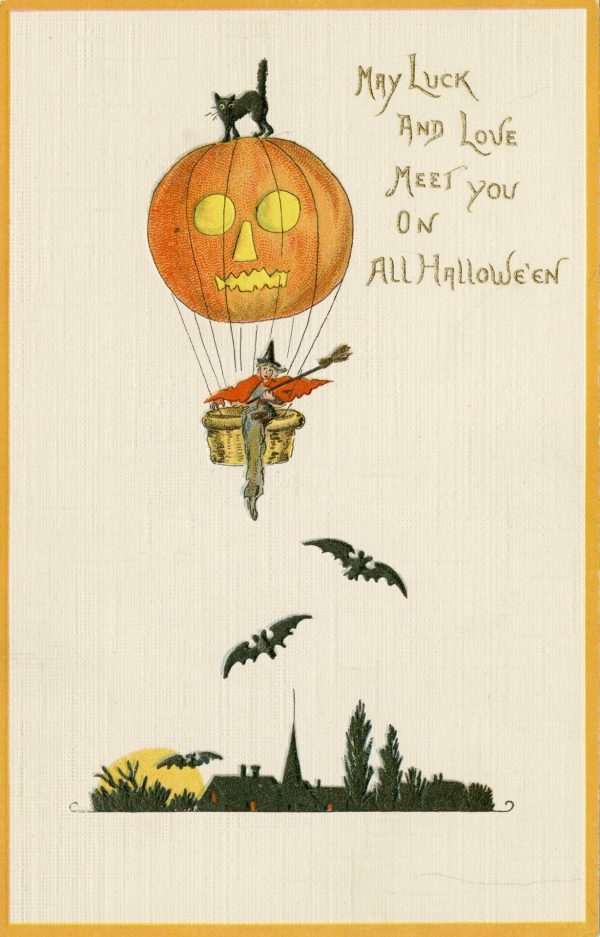
Image from Toronto Public Library greeting card collection